When we decided to move abroad, there were a lot of things to figure out, but one of the biggest was: how do we actually ship our belongings?
I asked around – people at my husband’s workplace who’d been on overseas assignments, friends who’d moved abroad, and people at other companies too – to find out how they actually sent their things.
What I learned is that, as a general rule, the best method really depends on your specific situation.
So first I’ll go over the options for shipping belongings when moving abroad, and then share our own experience.
- 4 ways to ship belongings when moving abroad (pros, cons, and cost)
- Why we chose to carry our luggage on our own flight
- Can you ship things in cardboard boxes? What we’d recommend packing in instead
- The storage cases we actually used, and how many of each
Ways to Ship Your Belongings When Moving Abroad
Broadly speaking, there are 4 options.
| Method | Pros | Cons |
|---|---|---|
| Sea freight | Can carry large quantities, even heavy furniture. Cheaper than air freight | Takes a long time to arrive (1-3+ months depending on the country) |
| Air freight | Arrives faster than sea freight (about 1-2 weeks) | May not accept large items. Generally about twice the cost of sea freight. |
| Carrying it on your own flight | Arrives the fastest – the same day. No worrying about loss or delay in transit | Airlines limit the number, weight, and size of pieces. You have to get it to the airport yourself |
| Forwarding services (informal shipping companies) | Very cheap (looser weight limits). | Only available for certain countries. Often no compensation for lost or damaged items. |

A friend who moved abroad shipped her things by sea, but customs flagged something during the voyage and she had to have every single box opened and checked. What was supposed to take a month ended up taking three.
Sea freight isn’t the only method that can run into major delays like this, so if there’s anything you’ll need right away, the safest bet is to carry it yourself on your flight.
Our Situation
In our case, we planned to decide on a home within a month of arriving, which meant we had no shipping address yet while we were still in Japan.
On top of that, sea freight from Japan to Ireland would take 3+ months, and even major international courier companies treated Ireland as outside their standard service area, which meant roughly double the usual cost.
Most of what we were sending was our kids’ toys. We wanted it to arrive as soon as possible (otherwise, by the time it arrived, they’d have forgotten about half of it or we’d have already bought replacements locally, and we’d be left wondering why we even bothered shipping it).
So we decided to carry our things ourselves on the flight.
What to Pack It In
Once we’d decided to carry everything ourselves, the next step was figuring out what to actually pack it in.
Option 1: Cardboard Boxes
If you watch people at an international airport, you’ll notice quite a few checking cardboard boxes as luggage. There are heavy-duty boxes made for flights, and as long as they’re within the size limit, airlines will check them.
What concerned me, though, was how sturdy they’d actually be.
And since Ireland gets a lot of rain, there was a real chance the boxes would turn soft and flimsy if it was raining when we arrived.
We were advised to hang onto whatever container we used on the way there, since we’d need it again for the trip back.
That meant either storing it at home the whole time, or dealing with it if it got rained on – and honestly, that felt like a lot to ask of a cardboard box.
Option 2: A Container
We’re not moving permanently – we’re planning to go back to Japan eventually.
I’d often heard of people traveling with a pile of suitcases, but figured that would just become a storage headache once we got there.
So I started thinking about what my ideal container would look like.
- Holds as much as a large suitcase
- Within the size airlines allow for checked bags
- Lightweight on its own
- Folds down compact when empty
- Sturdy (won’t break even with 30+ kg inside)
- Holds up well against water
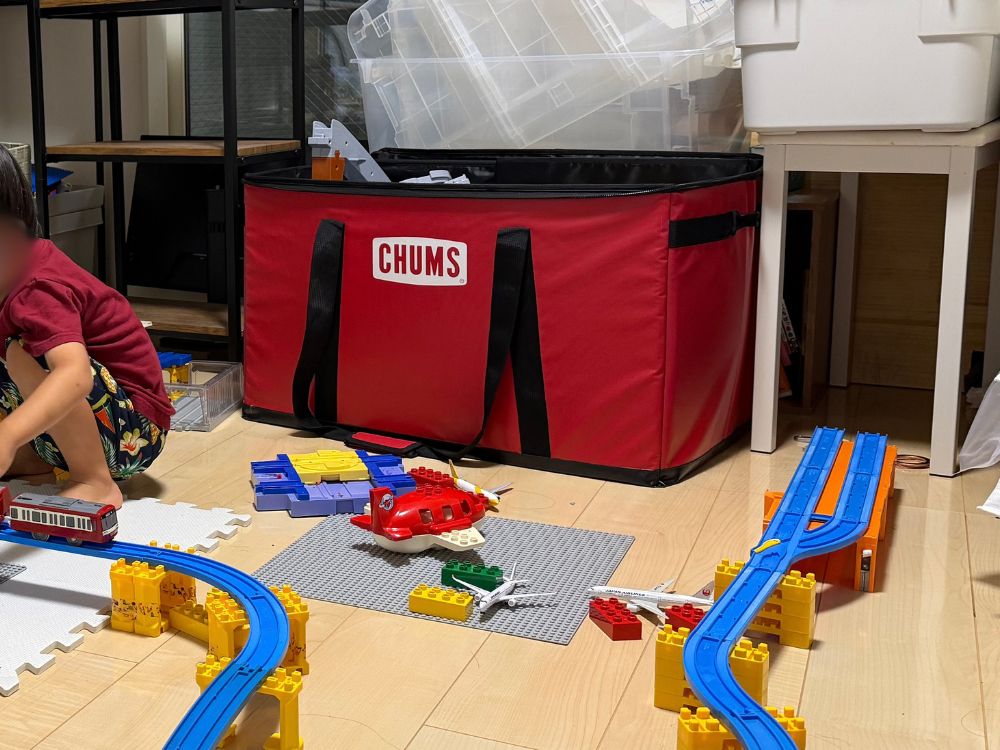
As it happened, we had a huge CHUMS (a Japanese outdoor brand) container at home that my husband had bought by mistake years ago.
It seemed like it would be perfect for the move, but the version currently sold is made of plastic, and it looked like it would crack right away if it got thrown around with anything heavy inside.
As I kept looking, I came across THE NORTH FACE’s BC Gear Container.
It’s a box-shaped container made from the same sturdy material as their well-known duffel bags – it folds down nice and compact, but the version sold in Japan holds over 100 liters. It resists water, dirt, and impact, and can easily handle heavy items.
So How Good Is THE NORTH FACE BC Gear Container, Really?
I bought one to try it out – and it turned out to be genuinely useful. It matched everything on my wish list.
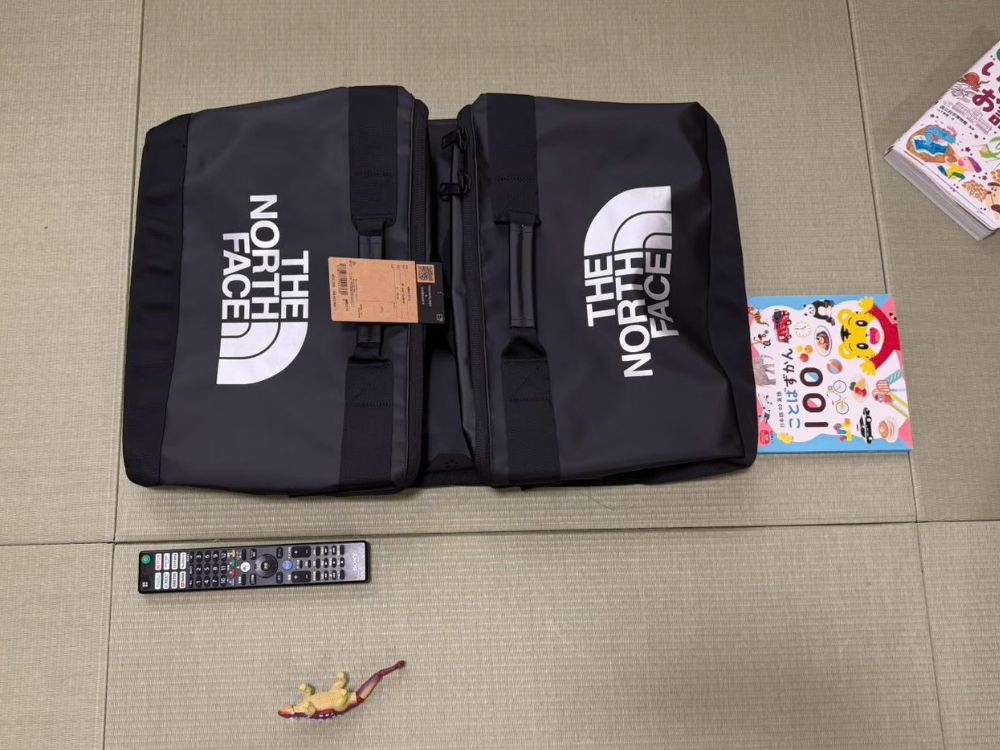
Here’s what it looks like folded up.
It doesn’t look all that big next to a picture book and a remote control, but…
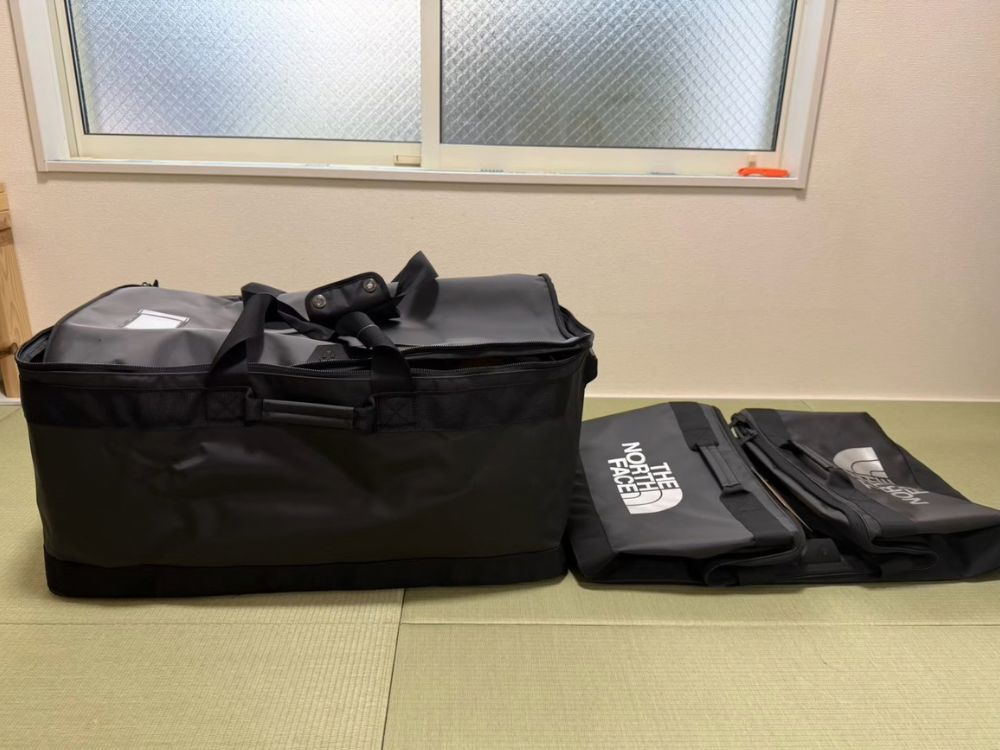
…here it is set up next to the folded version.
Compared to the window and the tatami mat below it, you can see just how much it opens up.
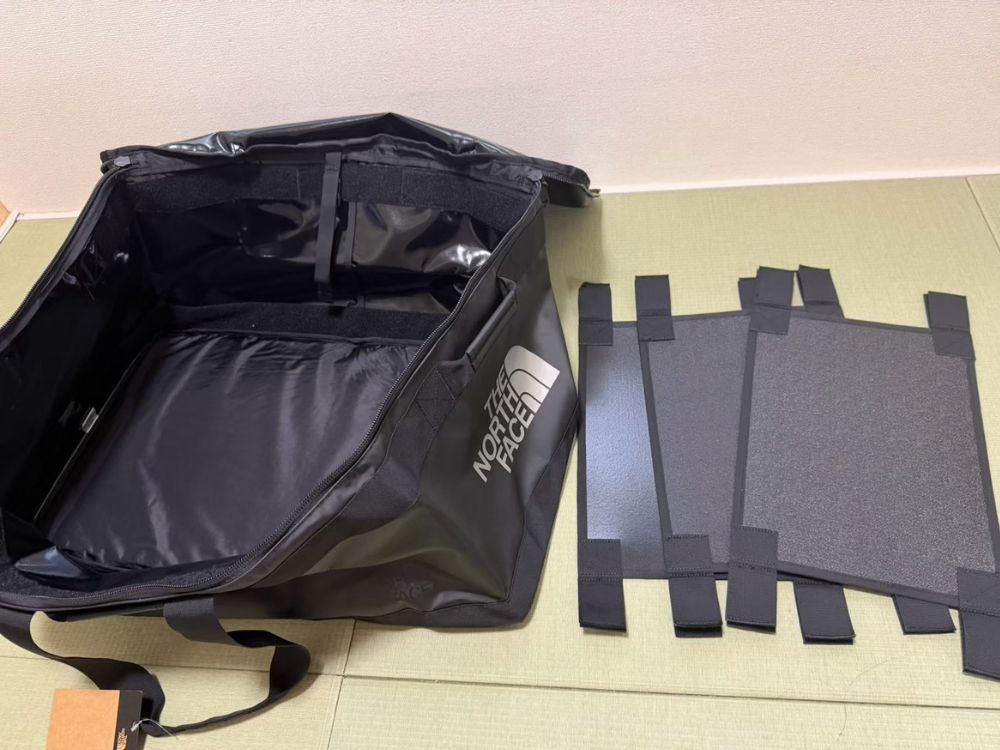
Inside, there are 3 dividers you can set up, and it holds up really well against pressure from above.
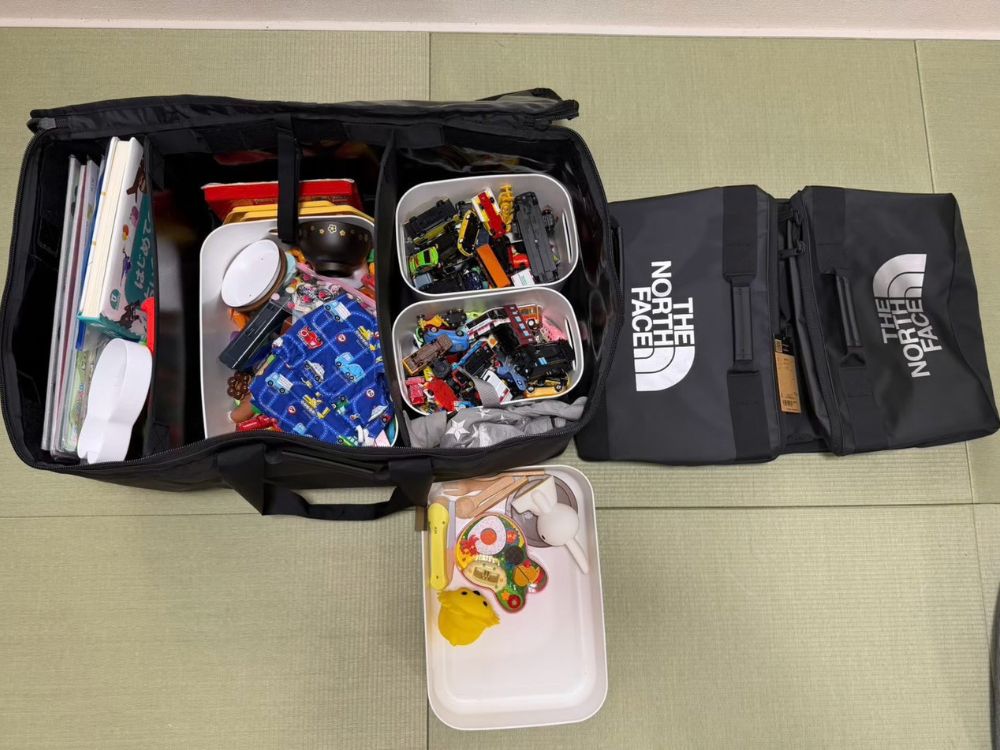
We had a ton of MUJI storage boxes at home that I figured we could use again after the move, so I sized the dividers to fit them and packed everything in around that.
Even after packing it completely full and adding a blanket on top, it still closed properly.
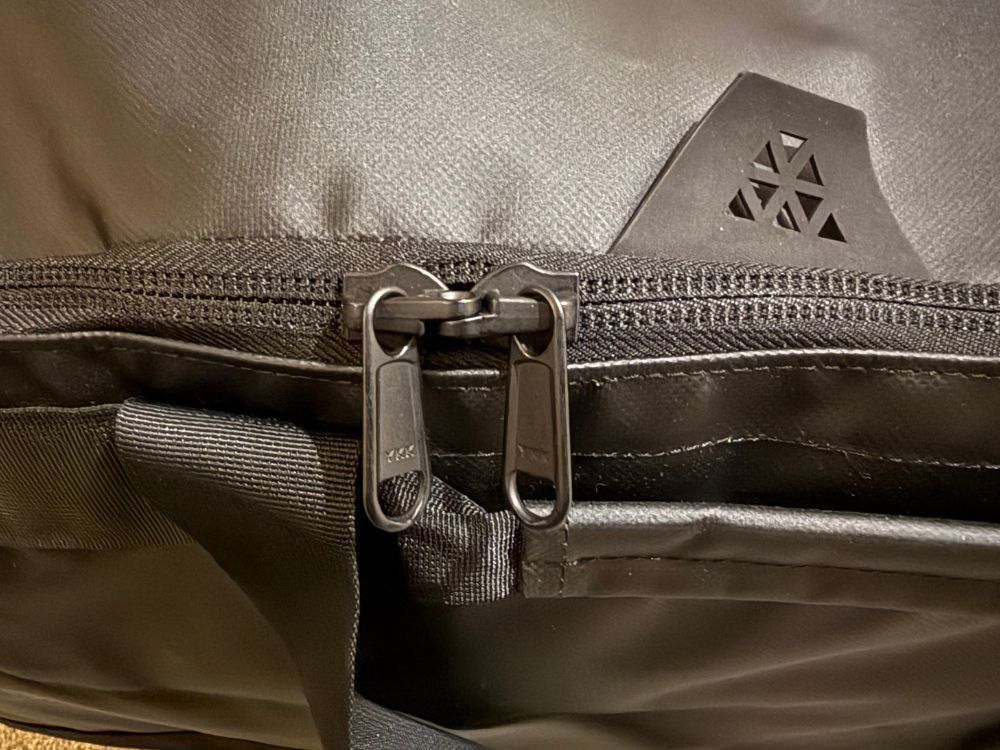
There are holes where the zipper pulls meet,
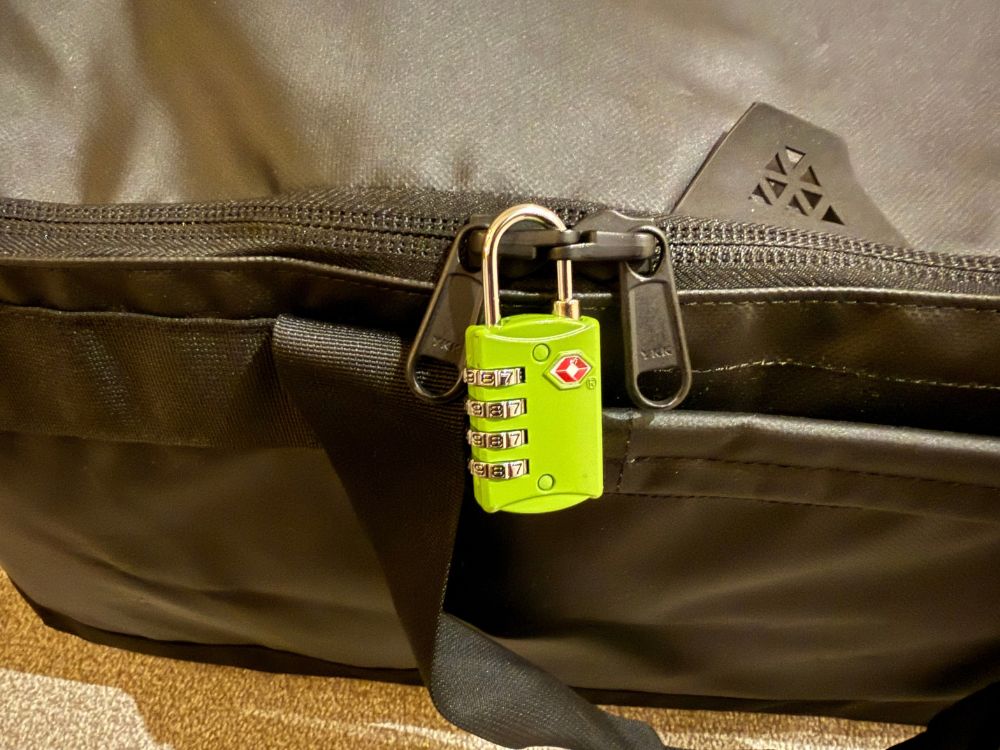
so you can lock it like this (the lock itself is sold separately).
It was so close to ideal that we ended up buying 4 more of THE NORTH FACE BC Gear Container.
- Holds as much as a large suitcase ⇨ 107 liters
- Within checked-baggage size limits ⇨ Yes, checkable
- Lightweight on its own ⇨ about 2.3 kg
- Folds down compact when empty ⇨ Yes, folds compact
- Sturdy (won’t break even with 30+ kg inside) ⇨ We actually carried 31 kg with no problem!
- Holds up well against water ⇨ Abrasion-resistant, highly water-repellent TPE fabric laminate
It checked every box on my wish list. We ended up buying 4 of these for the move, loaded each one with around 30 kg, and had zero issues using them.
Find THE NORTH FACE BC Gear Container (NM82373)!
About the Base Camp Gear Box—L
The exact product I bought is sold only in Japan. In the US (thenorthface.com/en-us), Canada (en-ca), the UK (sold for £135), and Europe (also available on North Face’s official sites outside North America, including in Luxembourg), a slightly different version is sold as the “Base Camp Gear Box.”
| International version (Base Camp Gear Box—L, NF0A81CC) | |
|---|---|
| Capacity | 90L |
| Material | 300-denier recycled polyester with TPU coating (Non-PFC DWR finish) |
| Weight | about 2.5 kg |
| Durability | Reviewers have tested it by tumbling it down stairs, dragging it across the ground, and tossing it in and out of cars, with barely a scuff to show for it |
| Dividers | 4 interior mesh pockets plus a zippered top-lid pocket |
| Unique features | Folding metal kickstands so it can stand upright and stack, plus a clear window to see what’s inside |
Here’s a summary of the Base Camp Gear Box’s specs.
It comes in 3 sizes: S (52L), M (65L), and L (90L).
The L size is the closest match to the one I bought.
Base Camp Gear Box – Large
Our Moving Luggage
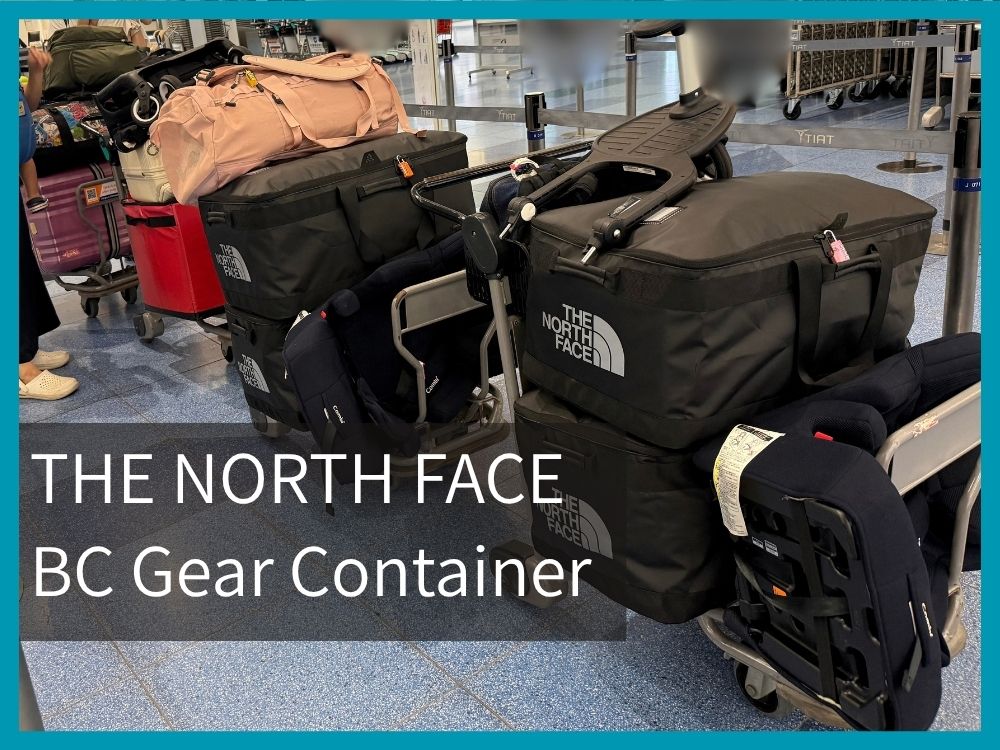
In the end, here’s everything we checked for our move – 13 pieces in total.
Suitcases: 2
CHUMS folding containers: 2
North Face duffel bags: 2
North Face BC Gear Containers: 4 (newly bought for this move)
Car seats: 2
Stroller: 1
Total: 13
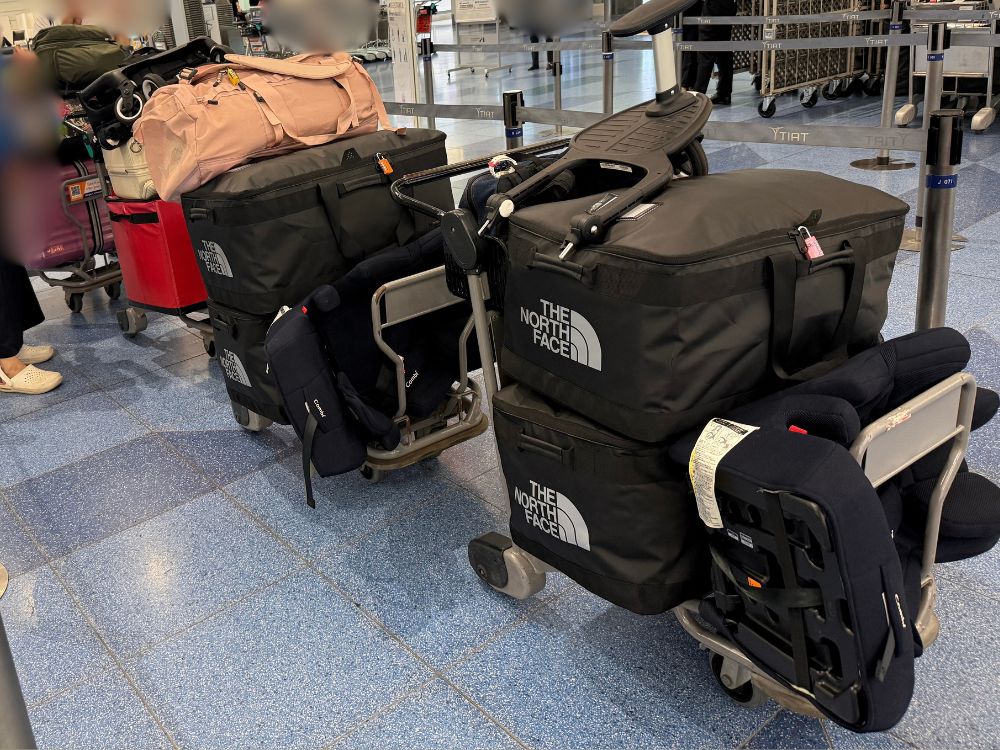
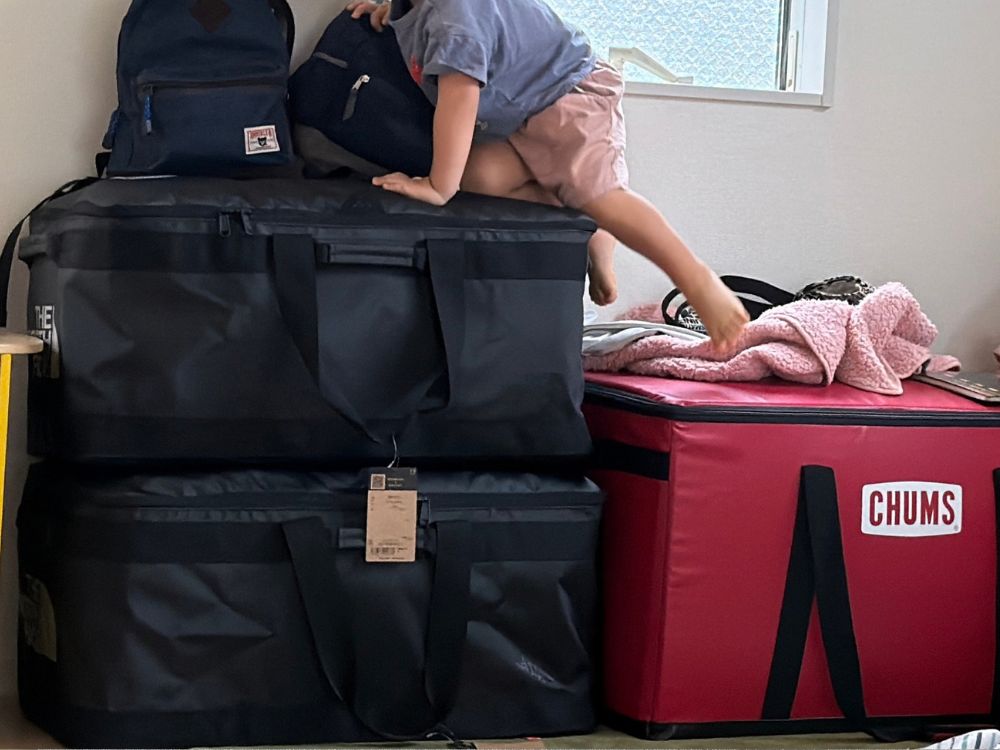
Here’s the photo from when we arrived at the airport.
Having everything in the same matching shape really helped – it stacked up stably.
I did wonder how on earth we’d manage all of this, but my brother and his wife came to help us at departure, and someone from my husband’s company came to meet us on arrival in Ireland, so we made it through just fine.
How Much Did the Excess Baggage Fees Come To?
Checked Baggage Rules
Checked baggage is free for up to 23 kg × 2 pieces per person.
Strollers and car seats are free (this depends on the airline, so double-check!)
Between my husband, myself, and our 2 kids, we had 4 seats total on the flight.
That meant we could check up to 8 pieces at 23 kg each for free.
We went over on the piece count by 2, plus a few pieces were over the weight limit, which came to about 100,000 yen (approx. $667) in total.

Adding up everything this move cost us: 4 North Face BC Gear Containers (about 80,000 yen / approx. $533), extra suitcases (about 90,000 yen / approx. $600), and the excess baggage fees (100,000 yen / approx. $667) – that’s 270,000 yen (approx. $1,800) in total.
Of course, we also shipped some food and bought a bunch of things after we arrived, but just looking at the cost of moving our belongings, I think we actually got off pretty cheap.
I completely understand now why so many people choose to carry their belongings on their own flight!
A Note on Duty-Free Declarations for Moving Belongings
If you’re moving abroad long-term, many countries have a system that lets you bring in your belongings free of customs duty and tax (examples include Japan’s “bessouhin” unaccompanied-baggage declaration, the US’s Form 3299, and Ireland’s Transfer of Residence relief).
- You’ve lived abroad for a certain period (often 12+ months)
- You’ve actually owned and used the items for a certain period (often 6+ months) – you can’t buy new items for the move and declare them as duty-free
- You import the items within a certain window after arrival (often 6-12 months)
Since half of what we brought was just toys, I honestly had no idea this existed – I only found out while researching for this post (ha!).
The requirements and how you actually declare it vary by country, so it’s worth checking the rules for wherever you’re headed ahead of time.
In Closing
There’s more than one way to ship your belongings when moving abroad, and the right choice will depend on your situation – whether your company covers the full cost of the move, whether they require a specific method, and so on.
As for THE NORTH FACE BC Gear Container, you can fold it up for storage, or just keep using it as a storage box once you’re settled in your new place.
It doesn’t have wheels, so carrying it does take some muscle, but airports have carts and staff who are happy to help, so between the airport and your destination, there weren’t nearly as many moments where we actually had to haul it ourselves as I’d expected.
I hope this was helpful!
Thanks so much for reading to the end.
Find THE NORTH FACE BC Gear Container (NM82373)!

We didn’t use it this time, but there’s also a smaller 25L version.
Smaller (25L) THE NORTH FACE BC Gear Container (NM82374)
Base Camp Gear Box – Large