This article is useful for anyone living in Japan — and also for those raising children abroad who want to keep Japanese in their lives. In our own case, with the possibility of an overseas posting on the horizon, we wanted to make sure our son had a solid foundation in hiragana while we were still in Japan.
I’ve been raising my eldest at home (he doesn’t go to daycare or preschool), and I’d hear from other parents that kids his age were already reading and writing hiragana.
He wasn’t interested in picture books at all — it was just trains, trains, trains. “How do I even get him interested in letters?” After a lot of trial and error, by age 4 he could read hiragana and katakana!
Many of the items I introduce here have a train theme — but similar products exist for every interest. Use this as a guide and find what works for your child’s favorite characters or topics!
While this article focuses on teaching hiragana to young children, the items featured here work just as well for adults learning hiragana from scratch. Feel free to use this as a reference too!
First Purchase: The Train Hiragana Picture Book

My eldest loved train encyclopedias — he wasn’t reading the words at all, just staring at the photos. But this book was perfect for introducing hiragana naturally, without any “now we’re studying!” pressure.
Whenever he picked it up and flipped through it like a regular encyclopedia, I’d casually say things like: “That’s the Kagayaki — ‘ka’ (か) is the first letter!” or “Hayabusa starts with ‘ha’ (は)!” or “Komachi starts with ‘ko’ (こ)!” Just dropping it into conversation, nothing forced.
He didn’t open it very often, but we started before he turned 3 — just little by little.
Check the price of the Aiueo Train Encyclopedia!The key is to scatter hiragana around your child’s environment. Once they start seeing the same characters in different places, they begin recognizing them on their own!
The Train Hiragana Tablet


Don’t worry if you don’t know hiragana yourself — when a child presses a button, the tablet speaks the character out loud. Kids can explore and learn completely on their own. And unlike tap-pen books where sounds play on accidental contact, pressing a button here requires real intention — which makes it much more effective for learning!
Press a button together and listen — even parents who don’t know hiragana can enjoy it right alongside their child!
We bought this when my youngest had stopped grabbing everything out of his brother’s hands (around age 3.5 for my eldest). We spotted it at Akachan Honpo — a major Japanese baby and children’s goods store — and my eldest was clearly interested, so we bought it on the spot, even though it was a little pricier there.
When I typed in his name, he immediately asked: “What about my brother’s name? What about Cha-chan? What about Dad? What about Kagayaki?” It was the first time he had ever shown genuine interest in letters!
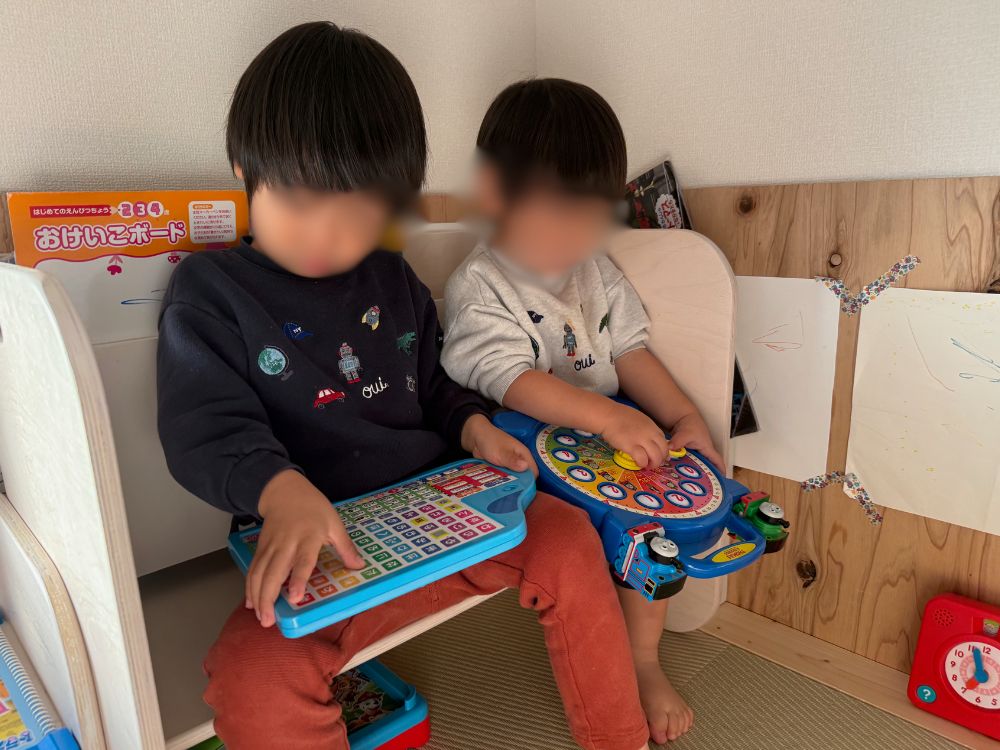
He pressed his name over and over, memorized it, and kept showing me what he had learned. Before I knew it, he was using it on his own — naturally getting in repetition without even realizing it.
The book section attaches magnetically and can be removed to save space.
My youngest was sitting right beside him, copying everything!
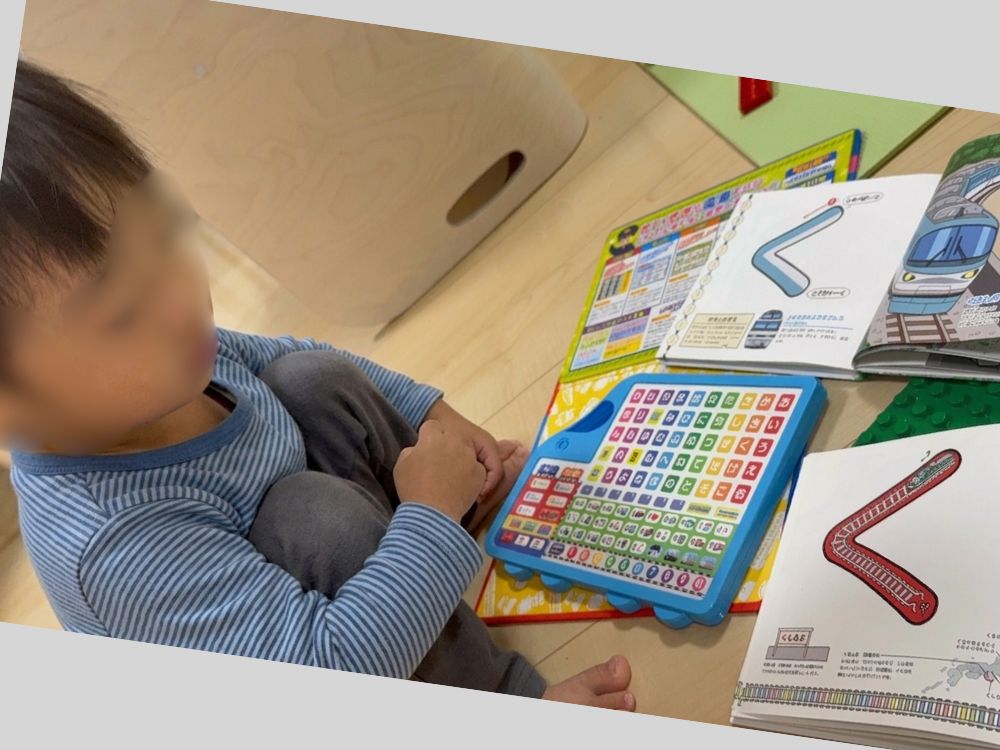
About a week after we gave him the tablet, he suddenly pulled out his hiragana picture book and said “They’re the same!!” — he had started recognizing the characters on his own.
This tablet also includes the alphabet and numbers 1-10, along with several different game modes. Since not everyone has a train-obsessed child, I’ve summarized all the features below — click to expand!
Character Mode
Press “あ” and it simply says “a” — the most basic mode. Great for pure character recognition.
Word Mode
Press “あ” and it says “Asoboi!” (あそぼーい — a real Japanese train name). Press “い” and it says “East i!” (イーストアイ — another real Japanese train). Each character is linked to an actual Japanese train name.
Character Quiz
“Which one is ‘a’?” — a listening game. Some pairs like “お” and “ほ” can be surprisingly hard to tell apart through the speaker!
Train Name Quiz
From easier questions like “East i (イーストアイ) starts with ‘i’ — which button?” to surprisingly specific ones like “Which character starts the Nemuro Main Line (根室本線)?” — it gets seriously train-enthusiast-level detailed!
English Letter Quiz
“Which one is ‘A’?” — a simple English alphabet recognition game.
English Word Quiz
“Which letter starts ‘Announce’?” — press A. A more advanced game where you guess from the illustration and pronunciation. Quite a challenge!
Train Quiz
From easy ones like “What color is Doctor Yellow (ドクターイエロー)? Answer in 3 characters” — きいろ (yellow), to surprisingly obscure trivia like “What animal inspired the design of the Kuroshio Ocean Arrow?” — いるか (dolphin). I had no idea and ended up Googling like crazy! (All the answers are in the included booklet — I found that out way later!)
Word Play
Press “う” and it says things like “I’m so itchy to see the Uzushio (うずしお)!” or “The Narita Express (成田エクスプレス) sneezed — N’EX!” — wonderfully silly Japanese train wordplay that just keeps going!
Other Recommended Tablets
There are so many hiragana tablets out there, but the best one is always whatever your child is excited about. Anpanman, PAW Patrol, Princesses — there’s something for every interest. Leave one somewhere your child can find it, and chances are they’ll start exploring it on their own.
I have borrowed an AGATSUMA tablet at a friend’s house many times — the buttons were easy to press and it seemed really durable.
The best thing about sound tablets is that even if a child isn’t sure of their answer, they can still press and hear what happens. Some kids freeze up when they think they might be wrong — but with a tablet, there’s no pressure. Just press and find out! That low-stakes repetition is what makes them so effective.

Kodomo Challenge (Shimajiro) Tablets
My youngest, who always wants whatever his brother has, inevitably decided he wanted the train tablet too. Rather than buying a second identical one, I wanted something different — a tablet where he would learn the actual characters, not just memorize them by position. So I started looking around.
Kodomo Challenge (こどもちゃれんじ) — also known as Shimajiro — is Japan’s most popular early childhood subscription learning program, run by Benesse. It delivers toys, books, and educational materials monthly as children grow. My eldest actually tried it at age 1, but since everything arrives gradually over time, we could never get a full set when we actually wanted it, so we ended up canceling.
Since I wanted to buy a full set all at once, I eventually found bundled listings on Mercari — Japan’s most popular secondhand marketplace app. Note that communication with sellers is in Japanese, but the app’s built-in translation feature can help!
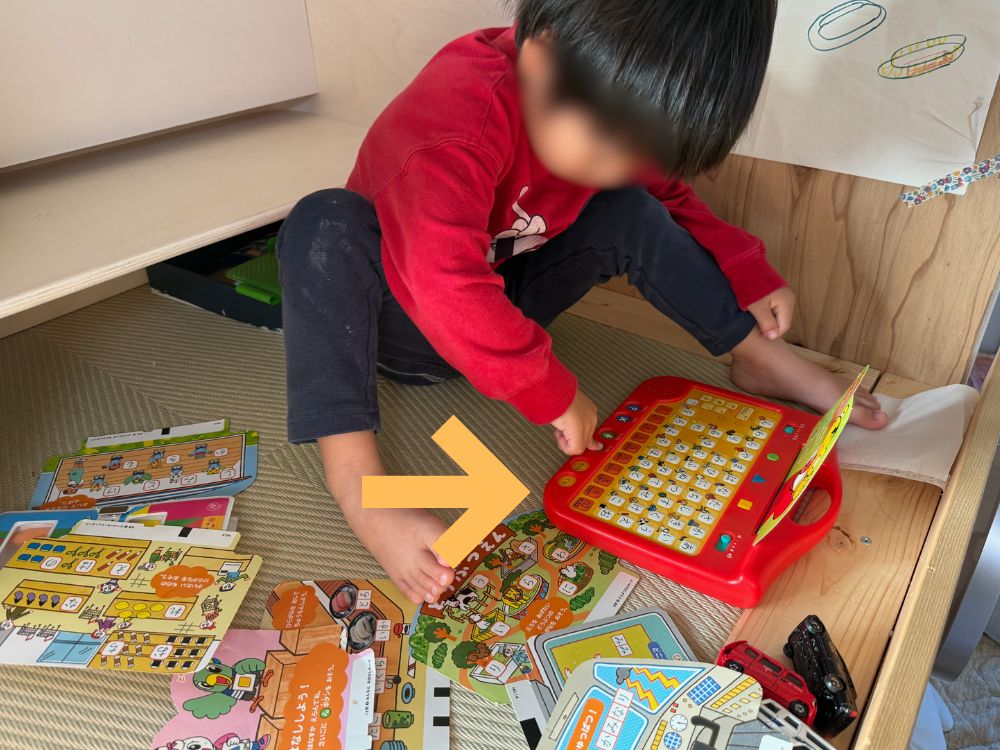
Some of what I bought was 5 to 10 years old — but hiragana hasn’t changed, so everything worked just fine!
Having a few different tablets around dramatically cut down on the arguments between my boys. And as an added bonus: by learning the same characters across different layouts, they couldn’t just memorize positions — they actually had to recognize the characters themselves.
One Tablet I Introduced Too Early — and Who It’s Better For
I had a Gakken tablet — the alphabet version. My younger son, who has good fine motor skills and is pretty strong, could press it just fine. But my eldest really struggled with the buttons. You need to press quite firmly right in the center, which makes it harder for younger kids compared to other tablet toys.
The Gakken hiragana tablet does include stroke order guidance, which is a nice bonus. If your child has developed reasonable dexterity and you want them to learn how to write the characters too, it could be a great fit!

Bath Posters

We had all kinds of train and boat bath toys, but they caused constant fighting — so I cleared them all out. A poster, I thought, would give us something to look at and talk about together. I went with a Curious George hiragana chart poster, since both boys were completely obsessed with him at the time.
It also includes katakana and romaji (the Roman alphabet representation of Japanese sounds), so it will be useful for a long time — and a great reference for parents learning alongside their kids too!
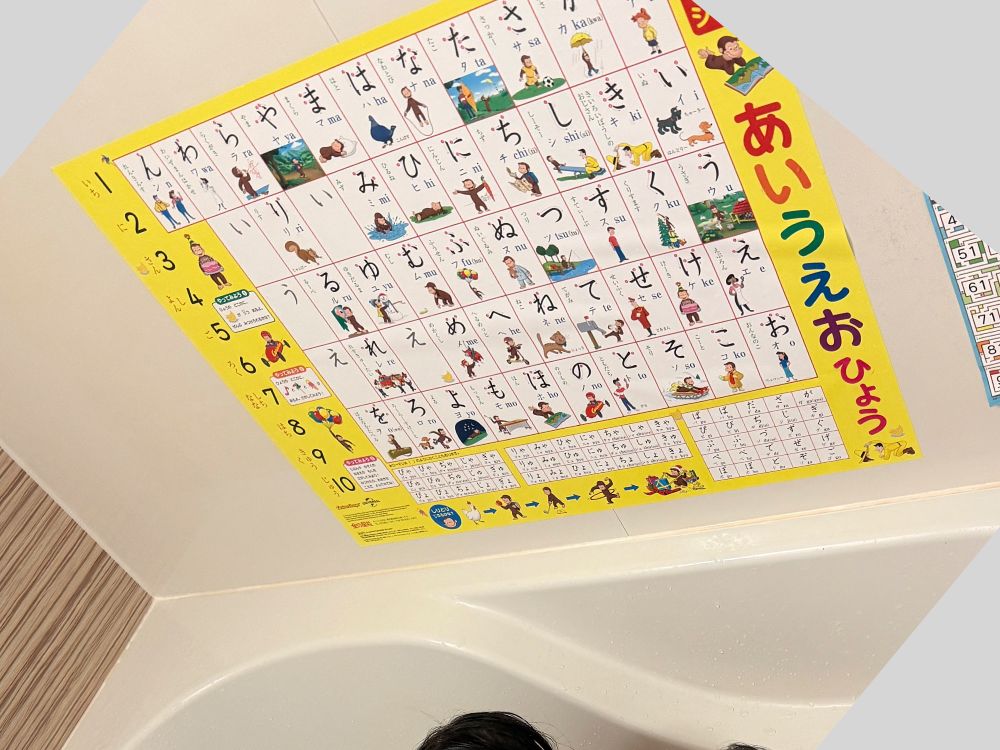
It is a good size on the wall — clear and easy to see. Since many of the characters are linked to character names they already knew, the boys engaged with it right away.
We actually have several different posters. I bought multiples mainly to prevent arguments, but there was an unexpected bonus: when they spotted the same character on two different posters, they would say “The ‘a’ (あ) is here too!” — making the connection on their own.
If you get two posters with different characters or themes, kids can play “find the matching letter” between them. It turns into a game, and learning moves forward without them even realizing it!
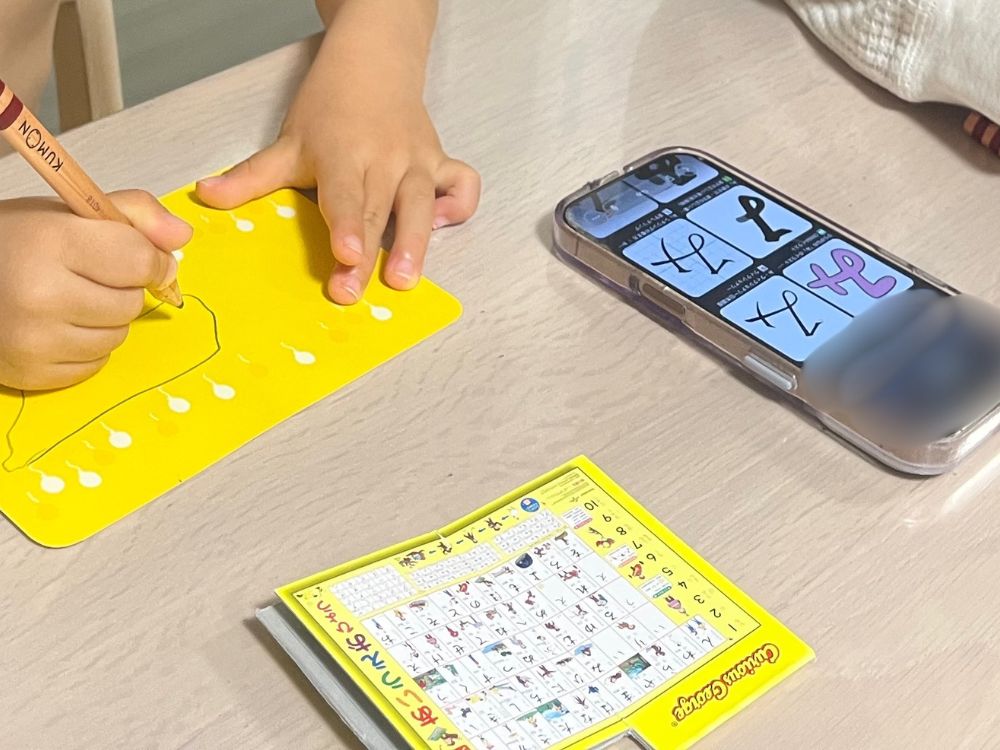
The poster came packaged in a box with a mini version of the chart printed on the side. I cut it out and it made a perfect little portable reference card — a thoughtful little design touch!
A Nurse Mom’s Take: Does Early Learning Actually Help?
You may have heard that getting a head start in early childhood doesn’t necessarily matter — that by the time kids reach elementary school, most of their peers catch up and any gap closes naturally.
This idea is sometimes referred to as the “fadeout effect” in early education research.
The knowledge itself — learned earlier than peers — tends to level out as other children catch up. Being ahead early doesn’t guarantee a lasting advantage.
So being able to do something earlier doesn’t mean staying ahead forever.
What matters isn’t how early a child learns something, but how that learning becomes genuinely useful in their life.
In our house, once the boys started recognizing hiragana, I would say things like: “Now you can read your train encyclopedias yourself!” or “That’s how I read subtitles so fast and learn song lyrics!” — connecting the skill to things they already cared about.
Why We Made a Point of Teaching It
Our situation had one extra dimension: the possibility of an overseas posting for my husband.
From what I had read about language development, children living in Japan absorb hiragana naturally — train station signs, snack packaging, shop names — it is everywhere. Many kids pick it up before starting school without any formal teaching at all.
But living abroad, the only script children see is the alphabet. Learning hiragana and katakana requires deliberate effort when there is no environmental exposure.
With that in mind, we made a conscious effort to bring hiragana into our daily home life — through toys, posters, and casual conversation — rather than sitting down to “study.”
Tips for Learning at Home
The most important thing: don’t push before the interest is there.
Once you sense a spark of curiosity, start with words that already mean something to your child — their own name, family members’ names, favorite foods, beloved characters. The first goal is simply getting them to press the right button on a sound tablet. That is enough to start.
If there is someone nearby who speaks Japanese, practice spelling out their name on the tablet beforehand and ask them in advance to make a big deal of it when your child shows them. The praise builds confidence — and being in a real situation where Japanese feels meaningful makes a big difference. It can also become a chance to pick up new words on the spot!
Take it slowly, repeat often, and keep the mindset: “You don’t need to know it yet — but when you do, it’ll open up a whole world.” That pressure-free approach is what keeps it going long-term.
Wrapping Up
Whatever you are trying to teach, the single biggest factor is the child’s own motivation. You can’t force it — but you can create the right environment for it to grow.
For anything you want your child to become interested in, the approach is the same: leave it somewhere they will encounter it naturally. Then, when they reach for it on their own, meet that moment with enthusiasm. Children absorb things like sponges when they are genuinely curious.
Kids’ education is something I will be figuring out for years to come — but ultimately, it is the children themselves who do the learning! My job as a parent is simply to make that environment as rich and enjoyable as possible.
Hope this is helpful!