The absolute must-see of Kyoto sightseeing, Kinkakuji (officially named Rokuon-ji)! It’s a UNESCO World Heritage Site and one of Kyoto’s most iconic temples.
This time we visited with a toddler, so I’ve put together everything worth knowing before you go with kids – highlights, seasonal appeal, stroller info, and more.
- Basic info and access for Kinkakuji
- What’s inside and the main highlights
- Seasonal appeal throughout the year
- Family and accessibility info
- How much time to set aside
What Is Kinkakuji?
“Kinkakuji” is the common name; its official name is Rokuon-ji. It’s a Zen temple belonging to the Shokoku-ji school of the Rinzai sect.
The gold-leaf-covered reliquary hall “Kinkaku” (the Golden Pavilion) is so famous that the entire temple complex has come to be known as “Kinkakuji.”
It was registered as a UNESCO World Heritage Site in 1994, as part of the “Historic Monuments of Ancient Kyoto.”
Its garden is also designated a Special Place of Scenic Beauty and Special Historic Site (a top-tier national heritage designation, one step above a standard “Place of Scenic Beauty”) – a treasure on par with a national treasure.
Founded by Ashikaga Yoshimitsu
Kinkakuji began when Ashikaga Yoshimitsu, the 3rd shogun of the Muromachi shogunate (Japan’s military government from 1336 to 1573), took over a villa from the Saionji family in 1397 and had it rebuilt as his own retirement villa, known as “Kitayama-den.” After Yoshimitsu’s death, it was renamed “Rokuon-ji” after his posthumous Buddhist name, “Rokuon-in-den.”
Basic Info
- Address: 1 Kinkakuji-cho, Kita-ku, Kyoto 603-8361
- Hours: 9:00 AM – 5:00 PM (open year-round)
- Admission: Adults (high school age and up) 500 yen (approx. $3.33) / elementary and junior high students 300 yen (approx. $2)
- Hours may differ during special viewing events
You Get an “Ofuda” Instead of a Regular Ticket
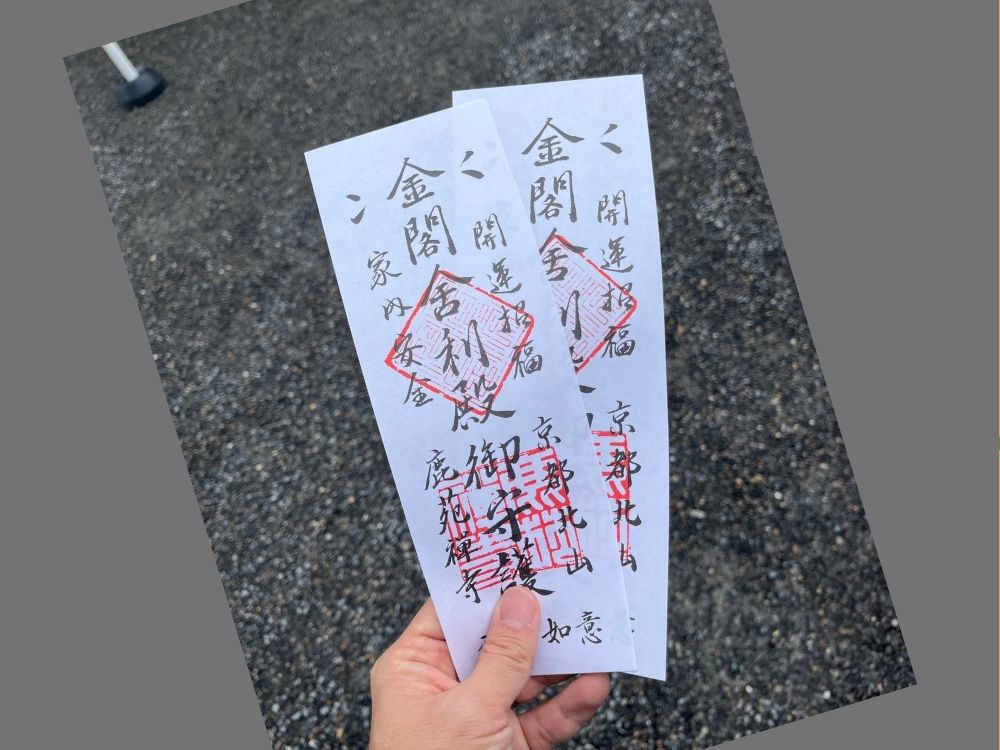
When you pay admission at Kinkakuji, instead of a regular ticket, you’re handed an “ofuda” (a paper charm).
It’s a good-luck charm you get to keep, and it makes a lovely souvenir!

Unlike a normal ticket, you get to take the ofuda home as a charm for household safety and good fortune.
If you don’t want to keep it, there’s a collection box for that too.
Access
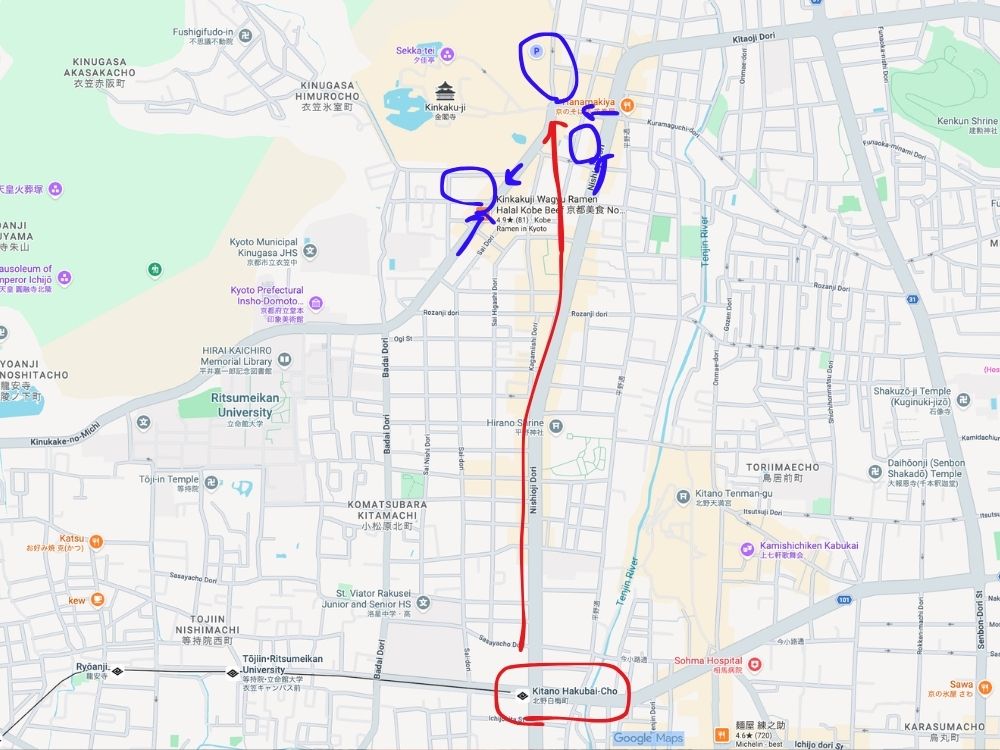
There’s no train station right by Kinkakuji.
The closest is Kitano-Hakubaicho Station, about a 25-minute walk away (marked in red on the map above).
By Car and Parking
Kinkakuji has Parking Lots 1 through 4 (250 spaces total), marked in blue on the map above. If you enter from the intersection in front of Kinkakuji, you’ll reach Lots 1 and 2.
Lot 3 is just before that, and a bit further in is Lot 4.
Hours: 8:40 AM – 5:10 PM
Rate (for cars): 400 yen (approx. $2.67) for the first 60 minutes, then 200 yen (approx. $1.33) every 30 minutes after that
During busy times, Lot 1 can get congested both going in and coming out, making it hard to move around. Depending on the situation, it may be worth using Lot 3 or a nearby coin-operated parking lot instead, even if it’s a bit farther.
By Train and Bus
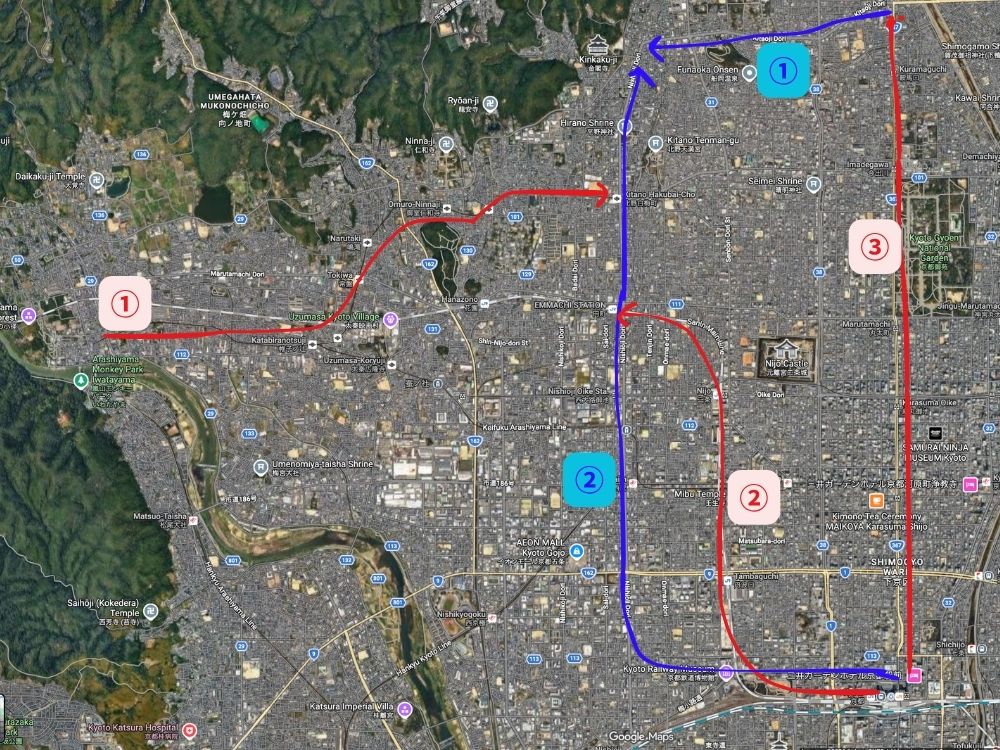
Here’s a bit more detail on the train routes from Kyoto Station or Arashiyama.
①Keifuku Kitano Line (Kitano-Hakubaicho Station)
②Sagano Line (Enmachi Station)
③Karasuma Line (Kitaoji Station)
①Route 204 or 205 (clockwise)
②Route 204 or 205 (counterclockwise)
*Routes 204/205 are loop buses, so they go all the way around.
Route 204 loops through a smaller area and doesn’t go to Kyoto Station.
Route 205 loops through a wider area that does include Kyoto Station.
Which one you take depends on where you’re boarding.
- From Kyoto Station: City bus route 204/205, etc. – get off at “Kinkakuji-michi,” about 40 minutes
- Via subway: Kyoto Station → Kitaoji Station (Karasuma Subway Line, about 15 minutes) → city bus (about 11 minutes)
- Via JR: JR Enmachi Station → city bus 204/205 (about 9 minutes)
Beating the Crowds (Before 9 AM or After 4 PM Is Your Best Bet)
Kinkakuji is a popular spot that draws crowds of tourists from Japan and abroad.
Because of that, it’s crowded not just on weekends and holidays, but on weekdays too.
The route is one-way, so you’ll still get a good look at Kinkakuji even when it’s crowded. But if you want to enjoy it at a slower pace, we’d recommend avoiding the peak hours of 10 AM to 3 PM, and instead going right at the 9 AM opening or aiming for after 4 PM.
What’s Inside (Highlights)
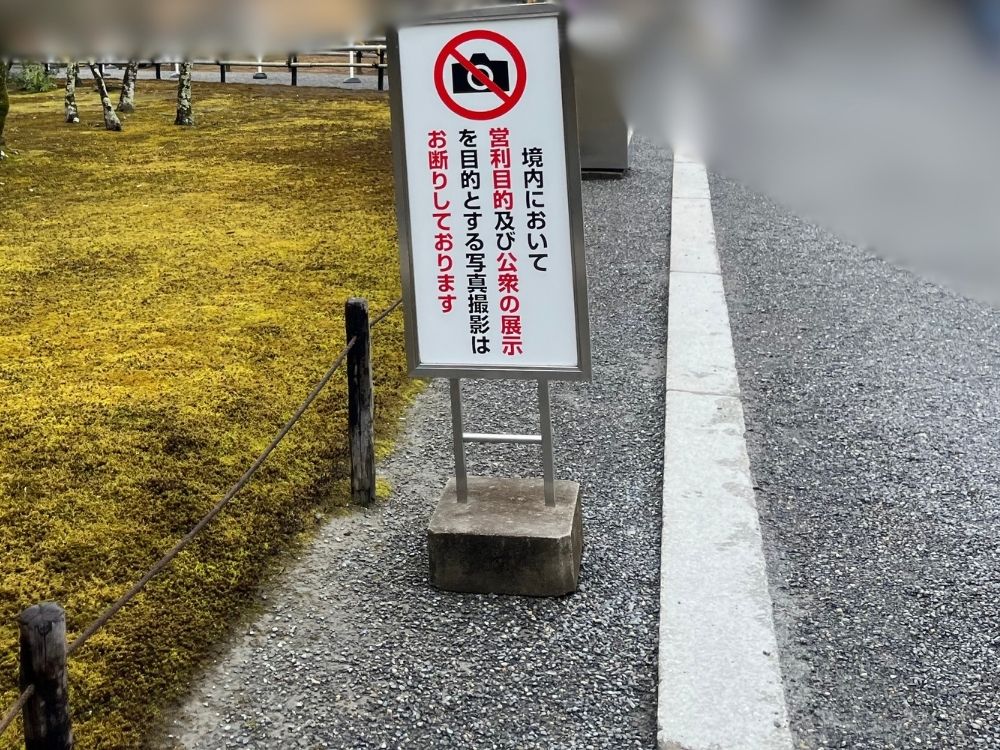
There was a sign like this, so to be safe, I’ll describe this part without photos.
Once you pass through the main gate, you’ll walk along a path covered in white gravel. It’s a quiet, solemn space.
More on accessibility later, but this gravel path gives you an idea of what the walk is like throughout.
Kinkaku (the Reliquary Hall) and Kyoko-chi Pond
As you continue down the path, the view suddenly opens up and Kinkaku (the reliquary hall) appears!
Kinkaku reflected in Kyoko-chi Pond (“Mirror Pond”) is breathtaking – a scenic highlight where everyone stops to take photos.
It’s a 3-story building, with the top 2 floors covered in gold leaf, and a phoenix ornament gleaming on the roof.
💡 The inside of Kinkaku (the reliquary hall) is not open to the public. You can only view it from outside, but it’s stunning and moving even so.
The Strolling Garden
Past Kinkaku, a strolling-style garden built around a pond opens up.
This beautiful garden, designated a Special Place of Scenic Beauty and Special Historic Site, can be explored slowly along a set path.
Seasonal Appeal
Kinkakuji shows a completely different face each season, making it a place you can enjoy year-round.
Here’s a summary based on roughly 50 years of Kyoto’s cherry blossom, fall foliage, and snowfall statistics.
Spring cherry blossoms: late March through early April (based on the last 10 years, the peak tends to land a bit earlier, around late March)
Early summer greenery: mid-April through mid-May (peak around Japan’s Golden Week holiday in early May)
Fall foliage: mid-November through early December
Winter snow: starts around mid-December, most likely to accumulate in January-February, with the last snowfalls typically in mid-to-late March
Since the appeal changes so much with the seasons, it’s the kind of place you want to visit again and again. The fall foliage and snow-covered Kinkaku seem to be especially popular.
Things to Know Before You Go
The Route Is One-Way – No Going Back
⚠️ The route through Kinkakuji is one-way! If you forget to take a photo and try to go back, you can’t. Make sure you get your photos in front of Kinkaku before moving on.
Family and Accessibility Info
You’ll Need to Carry Your Stroller (Gravel Paths and Stairs)
We saw plenty of people with strollers on the grounds, but once we actually walked it ourselves, we found gravel paths throughout, plus some stairs, so there are a lot of spots where a stroller is hard to push.
From the official site’s Q&A
Strollers and wheelchairs can turn back just before the stairs past Kinkaku and exit through the admission entrance.
We saw a lot of people carrying their strollers together with someone else’s help.
It’s not like you’re climbing a ton of stairs, but still,
Bring a Baby Carrier for Kyoto Sightseeing in General
Kyoto sightseeing often means visiting places that have preserved their old-fashioned layout, so a lot of other spots aren’t very accessible either.
On top of that, there’s a lot of gravel that’s easy to trip on, and with so many tourists around, it’s sometimes just easier for your kid to see over the crowd if you’re carrying them.
Also, kids can get sleepy at the most unexpected moments when they’re worn out from traveling.
We actually saw quite a few 4-to-5-year-olds being carried around while sightseeing, so even if you haven’t used a carrier in a while, it might be worth bringing one along – it can really come in handy!
Where to Change Diapers
- The multi-purpose restroom between the parking lot and the main gate: has a changing table
- The women’s restroom near the tea house on the grounds: has 1 changing table (there are stairs, so it’s hard to reach with a stroller)
It’s a good idea to change diapers at the multi-purpose restroom between the parking lot and the main gate before you go in!
We Didn’t Find a Nursing Room
We weren’t able to find a nursing room on the grounds. If you need to nurse, we’d recommend taking care of it beforehand at your hotel or a nearby cafe or shopping facility.
Nearby Sightseeing (Kinukake no Michi)
Walking along “Kinukake no Michi,” which continues west from Kinkakuji, gets you to other World Heritage temples too.
- Ryoanji: famous for its rock garden (about a 20-minute walk)
- Ninnaji: known for its National Treasure palace architecture (about another 15-minute walk)
It’s a popular walking route that lets you visit 3 World Heritage Sites in one trip, but if you have kids with you, it’s smarter to take Kyoto City Bus Route 59.
How Much Time to Set Aside
- Kinkakuji only: 30 minutes to 1 hour
- Taking lots of photos + strolling the garden: 1-1.5 hours
- Kinkakuji + Ryoanji: 3-4 hours
- All 3 World Heritage Sites (Kinkakuji + Ryoanji + Ninnaji): half a day to a full day
In Summary
The gold-leaf-covered Kinkaku and the view of Kyoko-chi Pond are beautiful no matter how many times you visit.
Pack light and enjoy your visit!
Thanks so much for reading to the end!