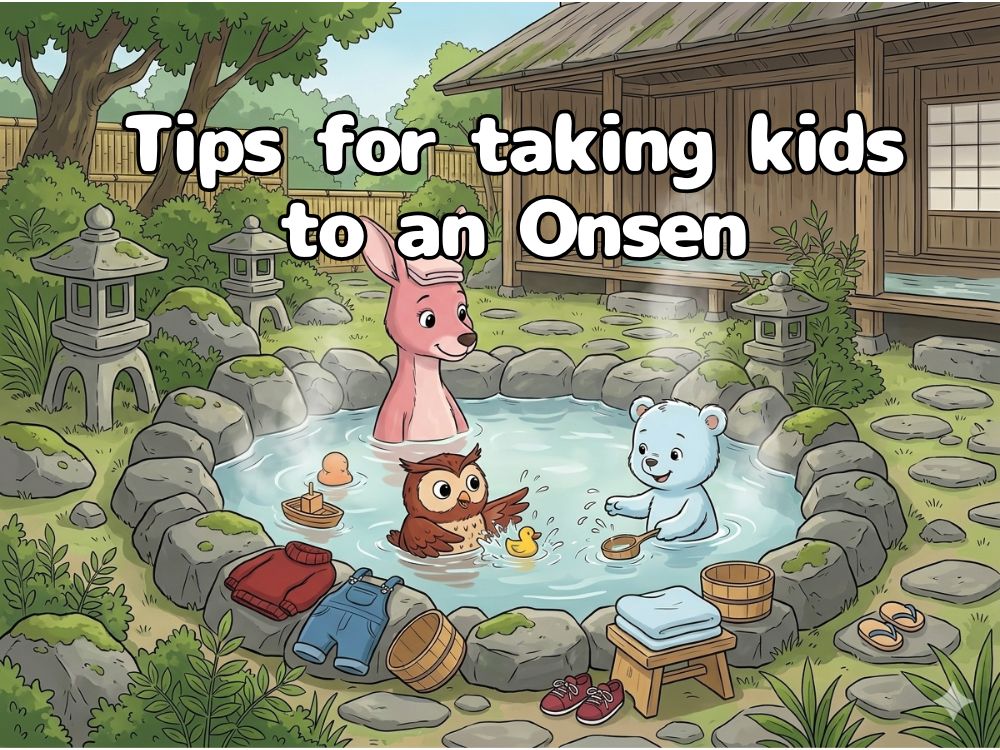
I’m Japanese, and I’ve been going to onsen (hot springs) since I was little. But taking babies and toddlers to a public bath was incredibly nerve-wracking at first.
So many “I forgot this!” and “I wish I’d done that!” moments along the way (lol).
After many visits, I’ve figured out an order and a set of tips that actually work. In this article, I’ll share everything I’ve learned — including some advice from my perspective as a registered nurse.
- Basic Onsen Rules (For First-Timers)
- ① Things to Check Before You Go
- ② What to Pack
- ③ Aim for Less Crowded Times
- ④ How to Pick the Right Locker
- ⑤ What to Know Before Entering (Nurse’s Perspective)
- ⑥ Post-Bath Dressing Order
- ⑦ Season-Specific Cautions
- Age Limit for Opposite-Sex Bathing
- Side Note: About Tattoos
- Wrap-Up
Basic Onsen Rules (For First-Timers)
- Enter naked: Swimsuits and underwear are not allowed
- Gender-separated: The large public baths are split by gender
- Wash before entering the bath: Clean your body at the shower/washing area before getting into the tub
- Don’t bring towels into the bath: Place them on the edge or on top of your head
- Tie up long hair: Make sure hair doesn’t dip into the bath water
- Be quiet: No loud talking or running
- Dry off before leaving: Wipe yourself down before stepping into the changing area

The “drying off before leaving” part is the easiest to forget. Bring a small hand towel into the bathing area with you!
Even I sometimes get out and realize “Oh no, I forgot my towel…”
Now onto the main topic! ↓
① Things to Check Before You Go
When Can Babies Start Onsen? Age Guidelines
There’s no official rule about when babies can start using onsen.
If you search online, you’ll often see “around 6 months” — but there’s huge individual variation in baby development, including neck control. Whether a baby was born early or close to their due date matters a lot, and growth pace varies from child to child too.
That’s why I personally think it’s fine to go even earlier — as long as the adult bathing with the baby feels confident handling them. If anything, neck control makes it significantly easier to manage a baby in the bath.
For my first son, my postpartum wounds took about 3 months to heal, so I couldn’t go out much. But for my second son, I had to travel just one month after he was born to visit a relative in hospital.
At onsen, I sometimes see families with newborn babies — because they’re tagging along with older siblings. Family situations vary, and so does the number of kids you’re managing.
Don’t decide based on age alone — pick what works for your specific situation!
Always Confirm: Are Kids & Diapers OK?
Many Japanese onsen don’t allow babies in diapers for hygiene reasons.
Hotel and ryokan (traditional Japanese inn) large public baths and onsen are generally diaper-friendly, but day-use bath facilities tend to be stricter.
There’s also regional variation within Japan — Kanto (the Tokyo area) feels especially strict about diapers. Even when the official website doesn’t say “no diapers,” I’ve been told at the entrance more than once: “Your child is in diapers? They can’t come in.”
Sometimes diapered kids can’t enter the bath itself — in which case I figure “okay, we can at least rinse off in the shower.” But what really hurt was being denied entry to the bathing area entirely.
The acceptance of diapered babies really varies by region. Mom friends in different parts of Japan have very different experiences — some are shocked (“Wait, diapers aren’t allowed??”) while others have been turned away before.
When the official site doesn’t have clear info, calling ahead is the safest bet.
② What to Pack
Prep is everything when bathing with kids. Here’s how I’ve come to organize things that genuinely make it easier.
The Essentials
- Pouch: Kids’ clothes, your own clothes, moisturizer, diaper kit — all in one
- Large towel (bath towel)
- Hand towel (small towel)
- Drinks
Bundling everything you’ll need after the bath into one pouch lets you dress everyone safely — without ever having to leave your child unattended on the baby changing bed.
For your own clothes, pick ones that go on easily even with damp hands.
What’s Provided On-Site (No Need to Pack)
Depending on the facility, baby-friendly onsen often have baby bath tubs and baby bath chairs (infant bath seats) ready to use.
Anything left out is free to use.
Sometimes there’s nothing. In that case, if your child isn’t walking yet, I recommend holding them on your lap to wash them.
If they can sit up well, just put them on the floor with a small bath bucket in front of them — they’ll happily play with water. Crawling and just-walking age is honestly the hardest stage (lol).
Once you get past that, kids start waiting nicely and stop wandering off on their own!
Nice-to-Have Items
Many onsen don’t stock baby soap.
I’m not too picky about it, so I just use the provided body wash diluted into a soft lather all over.
If it concerns you, bring your usual baby soap for peace of mind.
Even at facilities that stock baby soap, moisturizer is almost never available. So always include kids’ moisturizer in your bath kit!
That said, in my view moisturizer is low priority. Better to dress everyone quickly than to stand around naked in a panic (lol).
③ Aim for Less Crowded Times
Crowded baths simply mean more pressure to be considerate of others.
When it’s quiet, you can let your kid play with a bath bucket at the spot next to you while you finish washing — giving you the space and flexibility to actually deal with whatever comes up.
The sweet spots: right after check-in, just before or after dinner, and early morning baths. Asking the front desk about “busy times” beforehand is also a great move!
④ How to Pick the Right Locker
For small kids — especially under age 2 — choose a locker near the baby changing bed. When it’s crowded, occasionally someone will even put luggage on the changing bed (rare but it happens), so a position where you can keep an eye on the area is best.
When You Can’t Use the Baby Changing Bed: Backup Plans
- Lay a used bath towel on the floor: Great if (like me) you’d rather not put your kid directly on the floor after a bath.
- Sit them on a chair: If the changing area has chairs, sit your child down and dress them there.
- Dress in midair: Diaper first → fully dress yourself → strap on the baby carrier → dress your child last.
You can even dress both yourself and your child while holding them — it’s possible if you push through (lol). Bringing your baby carrier into the changing area, even if it feels a bit bulky, can really save you in many situations!
⑤ What to Know Before Entering (Nurse’s Perspective)
Timing & the “Poop Problem”
Honestly, the biggest worry when taking a baby to onsen is the “poop problem.”
If you’re anxious about it, going to the bath after they’ve eaten AND pooped is the safest bet.
Babies often poop right after eating. This is called the “gastrocolic reflex” — when food enters the stomach, the colon starts moving, triggering the urge to poop. Babies have an especially strong version of this reflex, so avoiding the bath right after meals is the safer move!
Breastfed babies in particular tend to have loose stools and poop many times a day. The first few months it’s hard to identify any rhythm, but as you spend time together you start to sense “ok, one might be coming” or “no, we’re good right now”!
Hydration Before Bathing Is Important
Hydrating before a bath matters for both adults and kids.
Onsen heat your body faster than a regular bath and make you sweat more — drinking water beforehand helps prevent overheating and dehydration.
Ideal Water Temperature for Babies
What feels just right for adults can be too hot for babies. The generally recommended range is 38–40°C (100–104°F).
That said, slightly hotter or cooler is totally fine in my book. Babies can’t talk, but they’ll definitely cry if they don’t like something (lol). Watching their reactions tells you when it’s time to get out or whether they’re still enjoying it!
Take Off the Diaper Last, Put It Back On First
This applies beyond onsen too — in the changing area, take the diaper off last, and put a new one on first right after the bath. This is the golden rule.
This gives you the most peace of mind to handle everything else. And mentally, “as long as the diaper is on, anything else is fixable!” really lowers the stress level.
⑥ Post-Bath Dressing Order
This is honestly the trickiest part. I had a lot of trial and error (lol). Here’s our family’s order.
- Before leaving the bathing area, wipe everyone down as much as possible with a small towel
- In the changing area, put a diaper on your child
- Put on your own underwear
- Step into your bra top from the feet up (a bra top is a tank top with a built-in bra — pulling it over your head when your hair is wet is a nightmare)
- Put on all of your clothes (if you’re not breastfeeding, a one-piece dress is the easiest!)
- Strap on the baby carrier
- Finally, dress your child
When my older son was about 1.5 years old. Thinking he might be cold, I dressed him completely first — and he, apparently feeling “done,” tried to bolt outside. I was completely naked. Total panic (lol).
If another guest hadn’t blocked him at the door, I would’ve been in serious trouble (lol).
After your child’s diaper goes on, dress yourself next! Stick to this rule.
If your kid is cold, just wrap them in a large towel — they’ll be fine!
Moisturizing Within 5 Minutes Is Ideal — But Don’t Stress It
Babies’ skin is said to be roughly as thin as an adult’s eyelid. Onsen warmth dries skin out, so ideally you’d moisturize within 5 minutes (10 at the latest) after drying off.
That’s the general guidance, but as I mentioned earlier, I don’t think you need to be super strict about it.
Applying lotion in a chilly changing room can actually drop a baby’s body temperature further, and other families might be waiting to use the changing bed.
Just diaper-on-plus-towel-wrapped is fine — moisturize later when there’s time!
(Skin varies a lot child to child, so do whatever works best for yours!)
⑦ Season-Specific Cautions
Mid-Winter: Watch for Temperature Shock
The big winter onsen concern is “heat shock” — known in Japanese as “hīto shokku” (literally “heat shock”). Often associated with elderly people, but kids are at risk too.
- Moving from a warm space into a cold changing area causes blood vessels to constrict and blood pressure to spike
- Then plunging into a hot bath causes blood vessels to dilate and blood pressure to drop sharply
- This rapid blood pressure swing puts significant strain on the heart and blood vessels
- Kids have underdeveloped temperature regulation and are more affected by temperature swings than adults
With small kids, winter onsen is surprisingly tough. Ideally the bath area and changing area would be similar temperatures, but the changing area is often unexpectedly cold.
Bringing one hand towel into the bathing area is enough to wipe down one adult and two kids.
This also prevents the changing area from getting soaking wet — so I always carry a hand towel in with me.
Snow-view open-air baths (yukimi rotenburo) are amazing, but I find them tough with small kids. In mid-winter, ryokan with great indoor baths might actually be more enjoyable.
Summer Open-Air Baths Are Actually Lovely
You’d think summer onsen would be too hot — but after sunset it’s surprisingly cool. Open-air baths (rotenburo) are especially wonderful then.
You can soak while looking at the stars, or step out for a moment to cool down in the evening breeze if you get too warm. The freedom to move around is a real plus over winter.
Watch out for mosquitoes at summer open-air baths! My younger son and I are bug-magnets, so sometimes we soak gracefully and come out itching all over (lol).
Age Limit for Opposite-Sex Bathing
In Japanese homes, families typically bathe together regardless of gender.
I bathed with my dad and brother through elementary school myself.
But at public facilities, the rules are different.
Recently, many regions and facilities follow “OK up to age 6, not allowed from age 7.”
Some facilities also add a height restriction — children over 120cm (~47in) may not be allowed even if they’re under 7.
Private family baths (kazoku-buro) — booked as a private room for your group — have no age or height limits. If you want everyone bathing together, look for facilities with private baths!
Side Note: About Tattoos
In Japan, onsen traditionally don’t allow visible tattoos. This stems from historical context — the Edo period’s irezumi-kei (a punitive practice of tattooing offenders), and later, post-Meiji-era associations with organized crime groups.
Personally I don’t mind tattoos at all, and most people today understand them as fashion. Especially for international visitors, the historical associations are even more disconnected — but the rules have been slow to change (lol).
There are now tattoo cover stickers — adhesive patches designed to hide tattoos for bathing. You can find them on Amazon or even at supermarkets.
For larger tattoos (like full back pieces), covering is impractical, and the large public baths can be hard to access. In those cases, private family baths are no problem, and some facilities have relaxed their rules. Worth researching ahead!
Wrap-Up
My husband loves onsen and apparently wanted me to relax there too — but I went through a phase where I came home more tired than when I went in (lol).
That said, once you have the pre-trip checks, packing list, and dressing order locked in, you’ll find your own rhythm after a few visits.
I have two boys, so in a few years I won’t be able to bathe with them anymore. Depending on the kids’ gender, the window for sharing the public bath with your child is genuinely limited.
Even when it’s tough, the memories last. Please enjoy your onsen time with your little ones!
Thanks so much for reading all the way through!