I always pictured SUP (stand-up paddleboarding) as just standing and drifting around (lol).
What got me really interested was a couple camping in the tent next to ours, who told us: “You can paddle a two-person board all the way around the lake! If you sit down you won’t fall in, so you won’t get wet, and if you stick close to the shore you can see fish and take breaks whenever you want.”
We actually tried it last year too, but my older son burst into tears at full volume because he was convinced I’d get swept away (lol), so this year was our real first attempt.
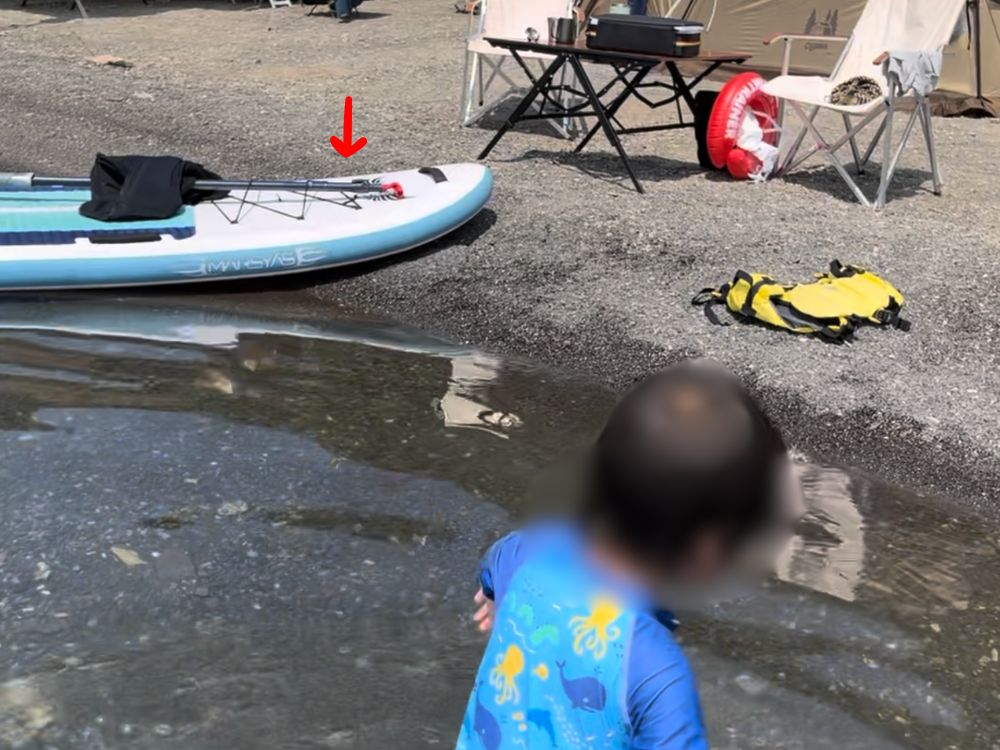
The SUP that almost didn’t make it out onto the water, just from renting alone..
Once we actually tried it, it turned out to be fun with kids — honestly, it might be one of the best activities out there for families.
This post is for anyone trying SUP with kids for the first time — everything we wish we’d known beforehand, including lake vs. ocean, how to sit, gear we’d recommend, and things to watch out for.
- Lake or ocean — which is better for SUP with kids?
- How to sit depending on your group (1 adult + 1 or 2 kids)
- Gear we’d recommend (kids’ paddles, viewing scopes, and more)
- SUP brands we’d recommend: STARBOARD and KOKUA
- What to watch out for with kids, and safety tips
- Where Should You Do SUP With Kids?
- The Basics You Should Know Before SUP With Kids
- How to Sit on a SUP With Kids (by Group Size)
- Gear We’d Recommend for SUP With Kids
- Things to Watch Out for When SUPing With Kids
- Safety Tips
- Thinking About Getting Your Own SUP?
- Where We Did This: Lake Motosu in Japan
- In Summary
Where Should You Do SUP With Kids?
There are tons of places to SUP, but not all of them are a good fit for doing it with kids.
I’ll get into safety in more detail later, but SUP is still water play — done wrong, it comes with real risk.
When you’re bringing kids along — especially kids too young to swim well — what matters most is “how easy is it to fall in along the way?”
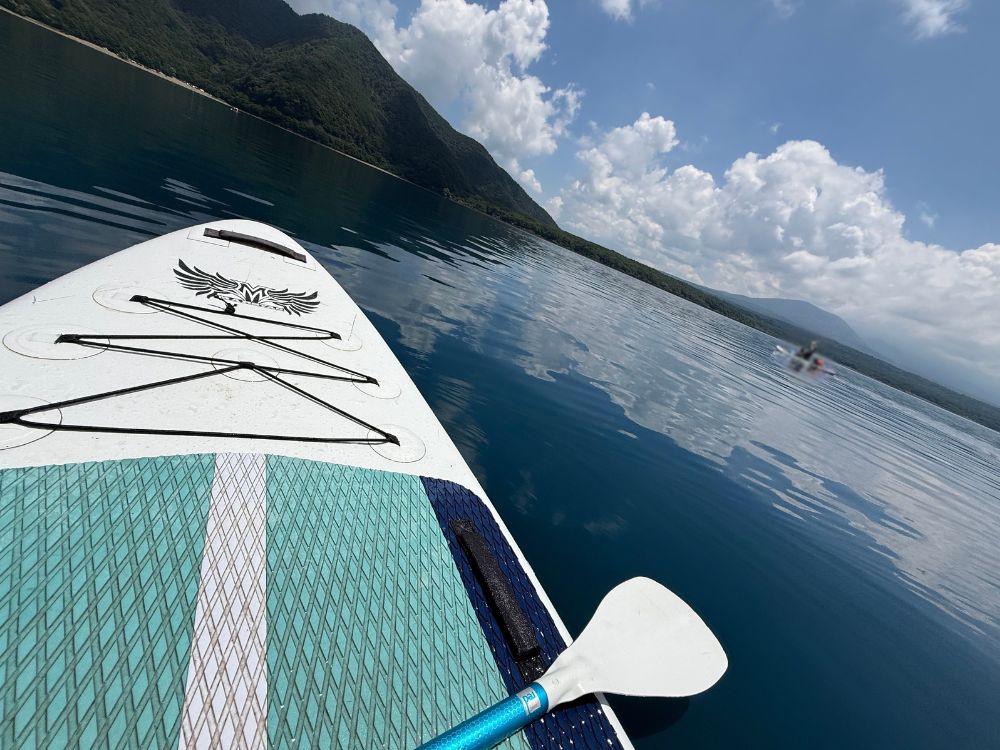
Bottom line: a lake is a better choice than the ocean when you’re bringing kids!
Lake vs. Ocean: A Quick Comparison
Here’s a table comparing lakes and the ocean.
| Category | Lake | Ocean |
|---|---|---|
| Waves/current | Almost none | Waves and tidal current |
| Difficulty | Beginner/family-friendly | Intermediate to advanced |
| Salt/stickiness | None | Yes |
| Risk of drifting out to sea | None | Yes |
| Scenery | Surrounded by mountains and trees | Open, expansive ocean views |
| What you’ll see underwater | Freshwater fish | Coral and marine life |

Once we actually got out on the water, even the smallest bit of chop makes the board rock, obviously. The ocean always has waves, but a lake stays flat as long as there’s no wind (of course, it depends on the specific lake!).
Also, when water splashes your face or you touch your face with wet hands, ocean water stings your eyes — a lake doesn’t have that problem, and it’s not sticky either.

One thing to watch for with lakes: the water is often colder than it looks. Depending on the season, that can bring a real risk of “cold shock,” so be careful.
The Basics You Should Know Before SUP With Kids
You Won’t Fall Off “As Long As You’re Sitting”
I always had this strong image of SUP as “paddling while standing,” but watching people SUP on the lake at the campground, way more people were paddling seated than I expected.
Sitting down lowers your center of gravity, which makes the board a lot more stable and much less likely to tip over.
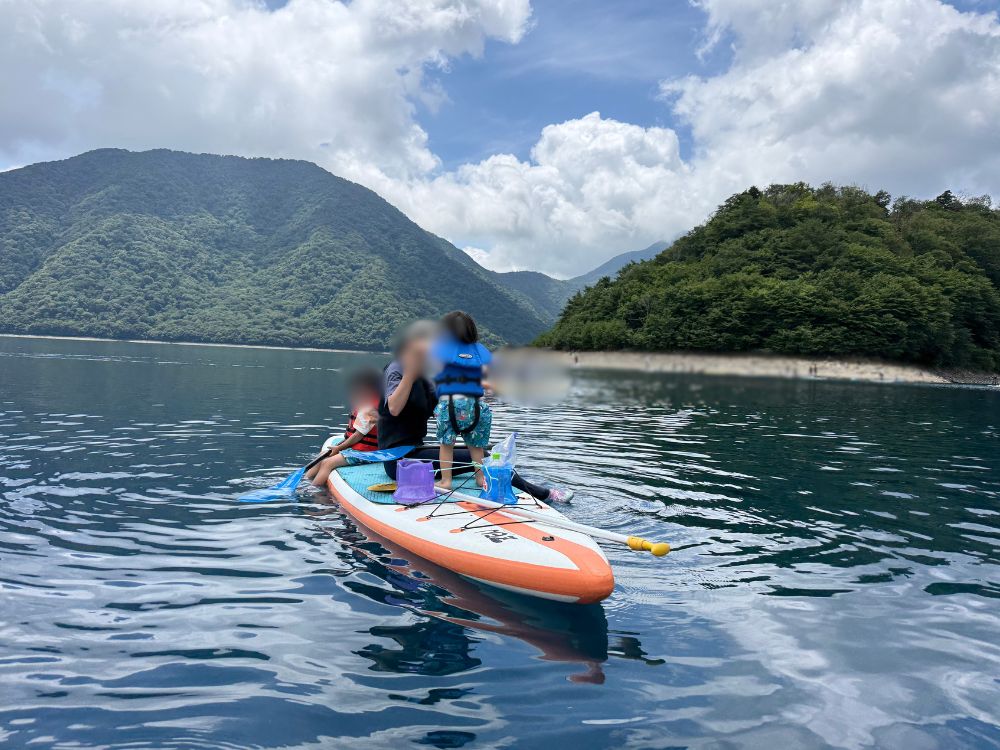
Like this — even with the kids moving around freely, the board stays well balanced.
Stick to the Shoreline — You Can See Fish and Take Breaks
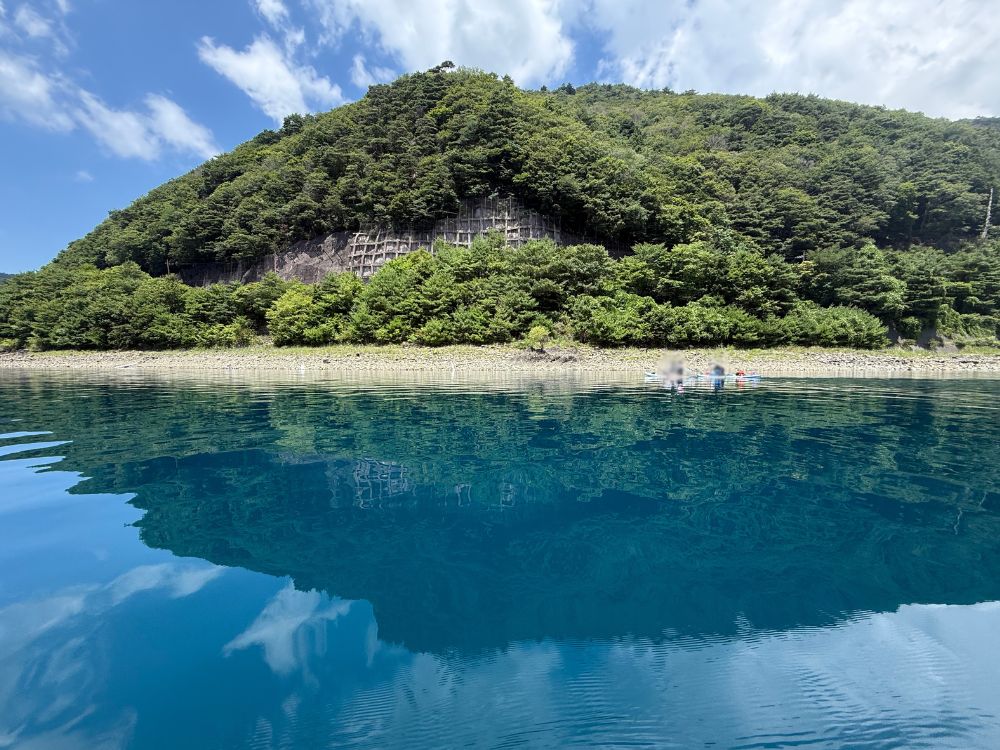
We’d recommend sticking to the shoreline rather than heading out to the middle of the lake. Where the water’s clear, you can see fish, which keeps kids entertained.
Being close to land also means you can pull ashore and take a break anytime, which is reassuring.
We once decided with a friend’s family to paddle over to the opposite shore, and it turned out to be way farther than it looked. Depending on the wind direction, you can also end up barely moving even while paddling hard, so staying close to land is the safer bet.
How to Sit on a SUP With Kids (by Group Size)
First, let’s cover how to get everyone on board before you launch!
SUP is actually at its least stable right when you’re launching.
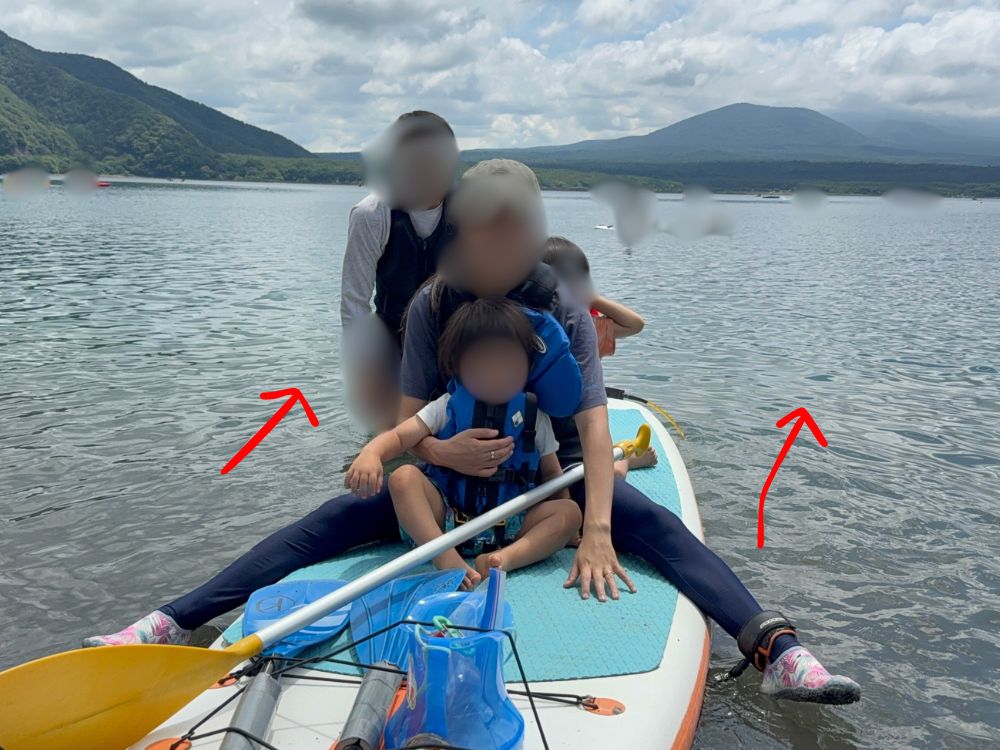
It’s safest to have everyone climb on while the board is still touching land, like this, and then have someone pull it out from behind.
It felt wobbly and a little scary at first, but we got used to it surprisingly fast! Once the kids got comfortable too, we were able to launch on our own.
1 Adult + 1 Kid → Kid Sits in Front
With one kid, we’d recommend seating the child in front of the adult. It’s easier to keep an eye on the kid, and paddling stays more stable too.
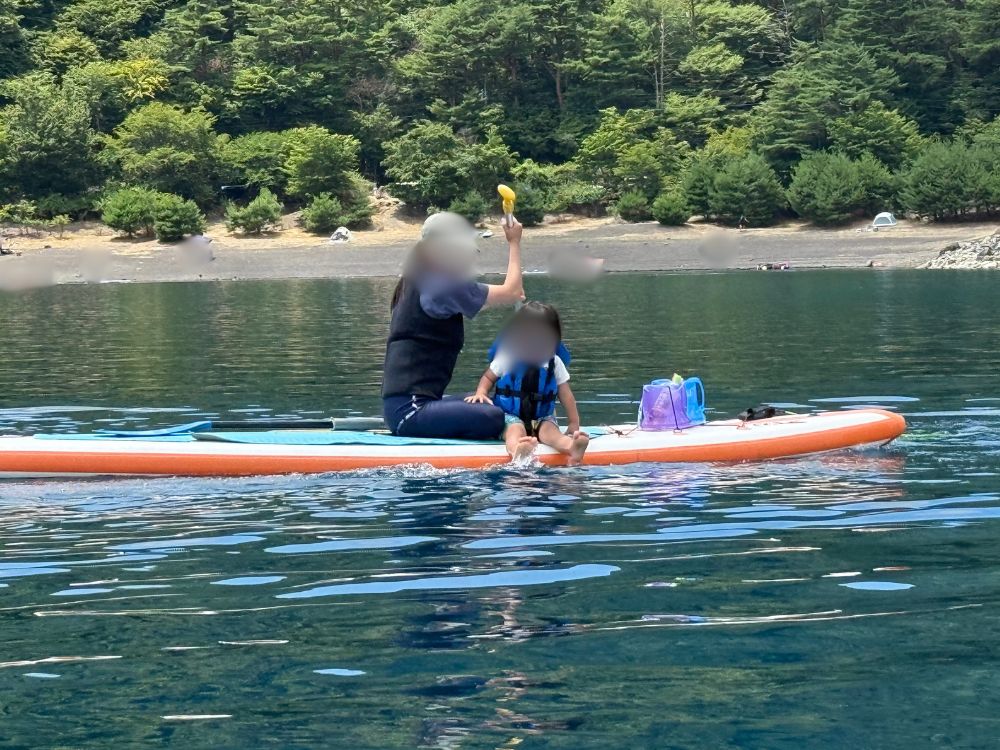
1 Adult + 2 Kids → Adult Sits in the Middle
With two kids, the adult sits in the middle, with a kid in front and one behind.
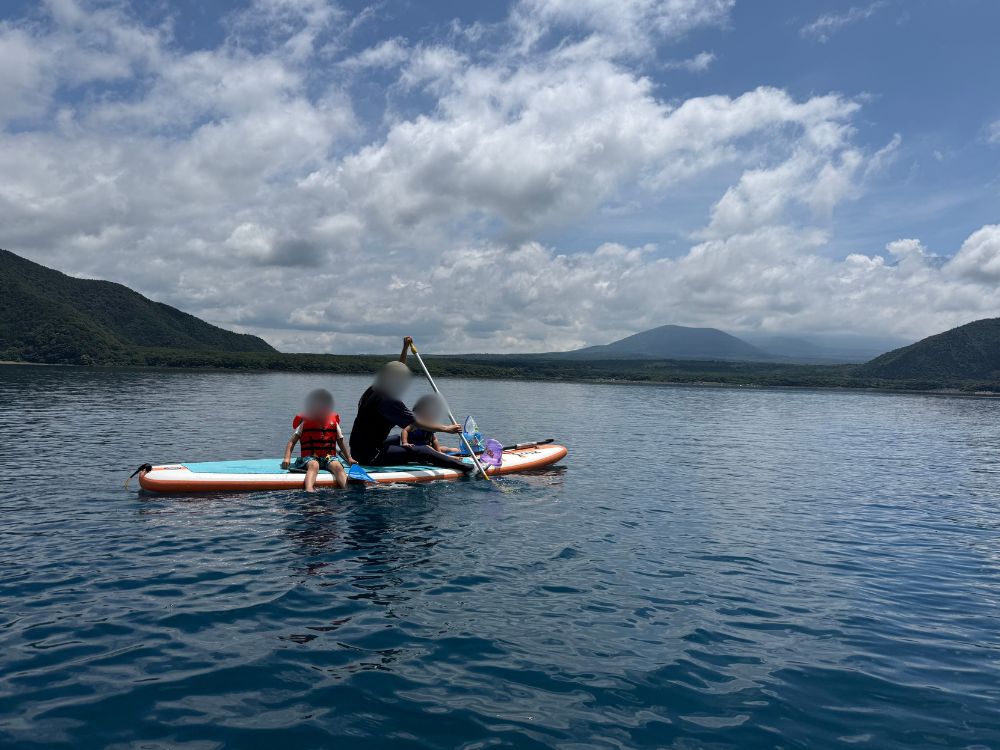
When we asked the rental shop how to seat two kids, they told us to put them front and back rather than both in front.
It really is easier to balance this way, and it feels much more stable.
It also cuts down on sudden sibling squabbles, which is a relief (lol). Since it’s hard to see the kid sitting behind you, we had our older son take that spot.
Not just with kids — whenever you’re playing out in nature, it’s important to keep an eye on each other and help out if something looks unsafe.
Go With a Two-Person Board (More Buoyancy, Wider Deck)
There are tons of SUP types out there, but for most people, boards come in either single or two-person versions.
This time, I tried renting both.
1 adult + 1 kid → single board.
1 adult + 2 kids → depends on the weight/build of the riders.
2 adults + 1 kid → two-person board.
The two-person board had noticeably more buoyancy, a wider deck, and felt much more stable.
Even with a kid sitting sideways, it didn’t wobble, and there was a real sense of security even when someone moved around on it.
I’m about 5’3″ (160cm) and just under 110 lbs (50kg), and on the single board with a kid front and back there was still room to spare — but my husband, at 5’8″ (173cm) and 154 lbs (70kg), looked pretty cramped on the single board.
By the way, if you go over the weight limit, the board sinks and flexes. It gets harder to paddle, and it’s obvious as soon as you look at it — if that happens, cut down on riders or switch to a more buoyant two-person board!
Gear We’d Recommend for SUP With Kids
Kids’ Paddle (Easier to Switch Hands)
SUP paddles are built long, on the assumption you’ll be standing. You can absolutely paddle seated too, but with a kid sitting in front, it was hard to switch the paddle from side to side.
A kids’ paddle felt short and light enough to switch hands easily.
It’d be amazing if the kids could paddle along with us, but my 4-year-old older son mostly just hit the brakes (lol). The elementary-school-age kids we saw were paddling on their own just fine, even two kids to a board!
Food and Drinks
This might be one of the best parts of paddling seated!
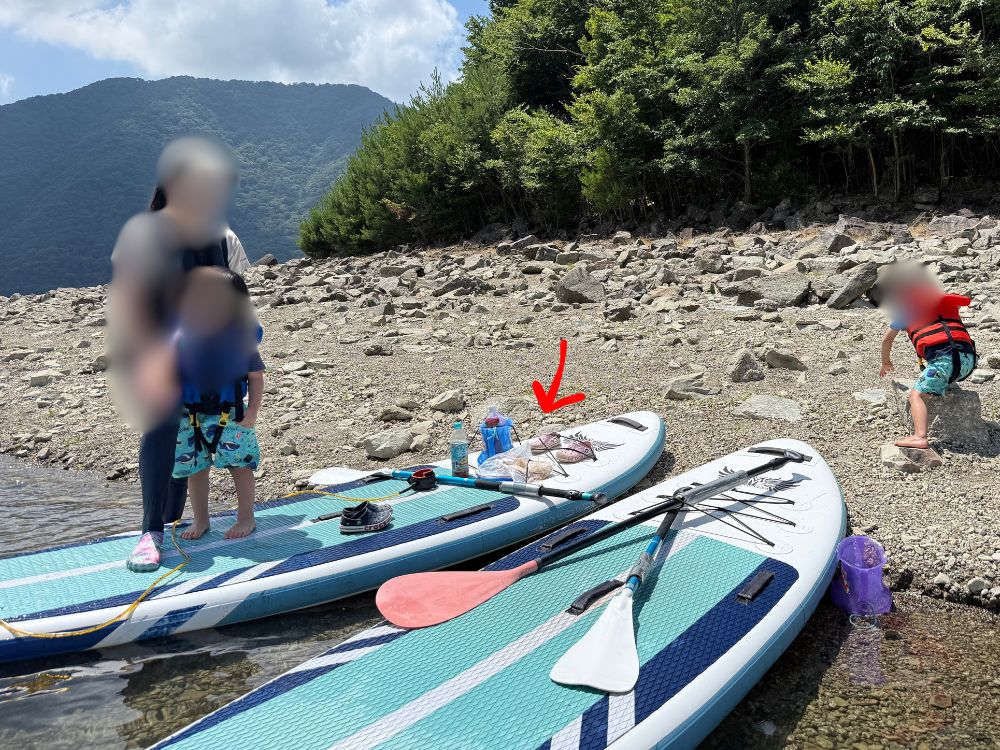
Like this — you can use the bungee straps up front to bring along food and drinks.
A carabiner makes it even more convenient.
You can even bring diapers and wipes if you pack them in a zip-top bag. Nobody wants to head back early after going through the trouble of getting out there, so bring everything you’ll need!
We saw people bring a small cooler along and just relax with a book.
A ReefTourer Viewing Scope (Great for Watching Underwater)
A ReefTourer viewing scope — a boxed scope for looking underwater — lets even little kids who can’t snorkel yet enjoy watching what’s below the surface.
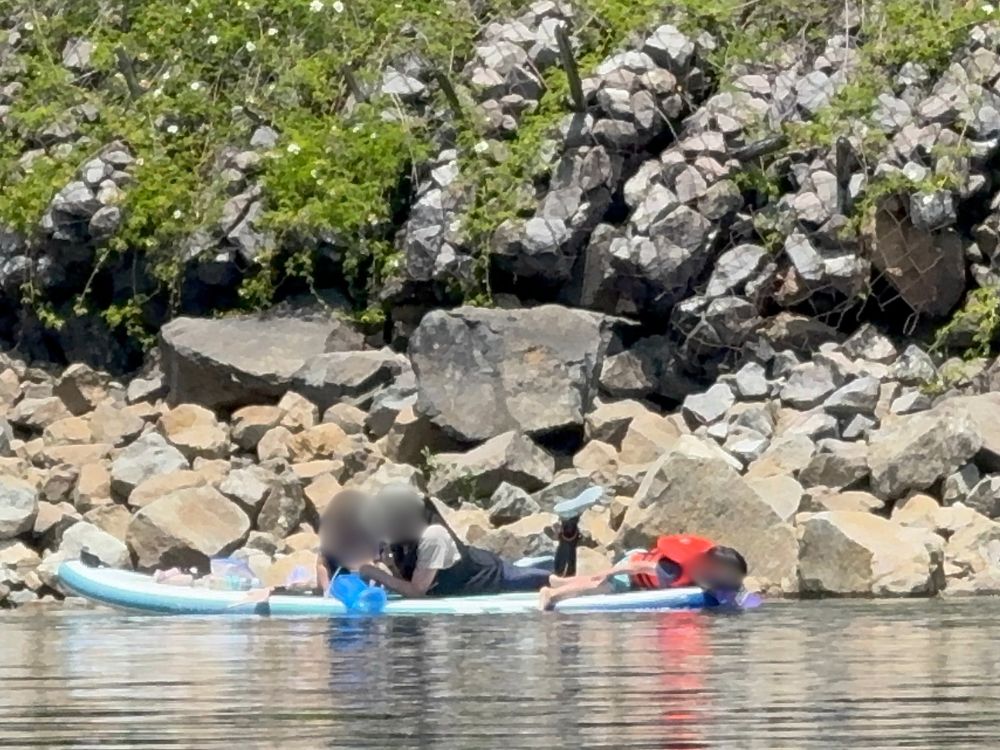
Our older son just sat there at first, but before long he was completely absorbed in watching.
It’s easier to keep paddling if someone else watches from behind.
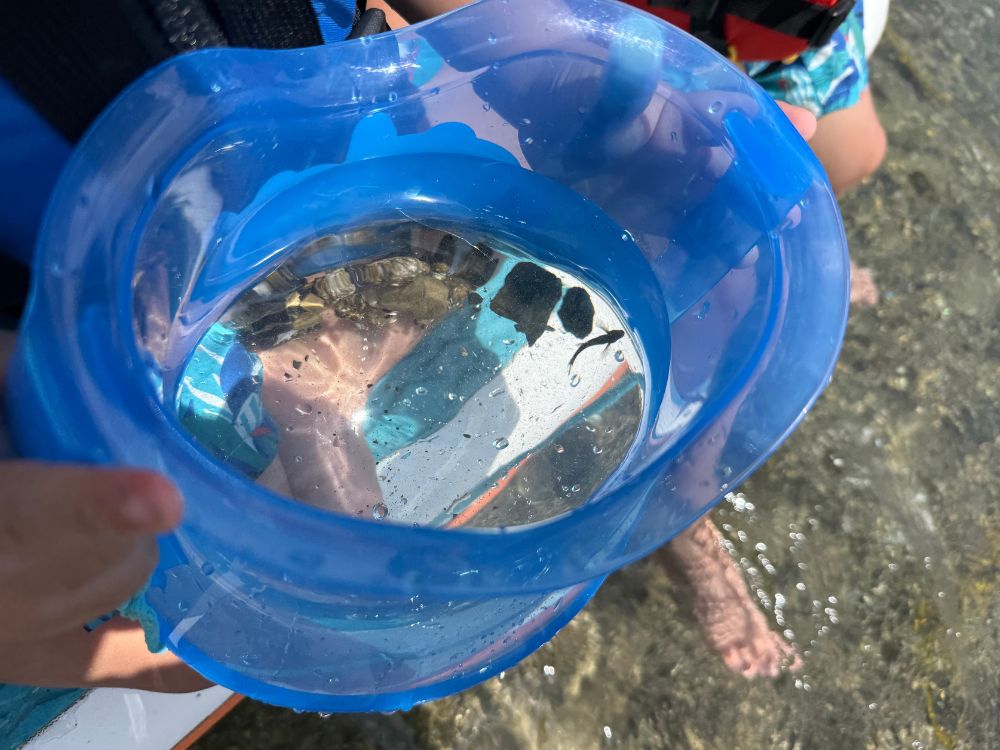
You can even catch and observe fish like this.
We saw parent-child pairs snorkeling right alongside their SUP as they paddled along. There’s really no limit to how you can use one!
Things to Watch Out for When SUPing With Kids
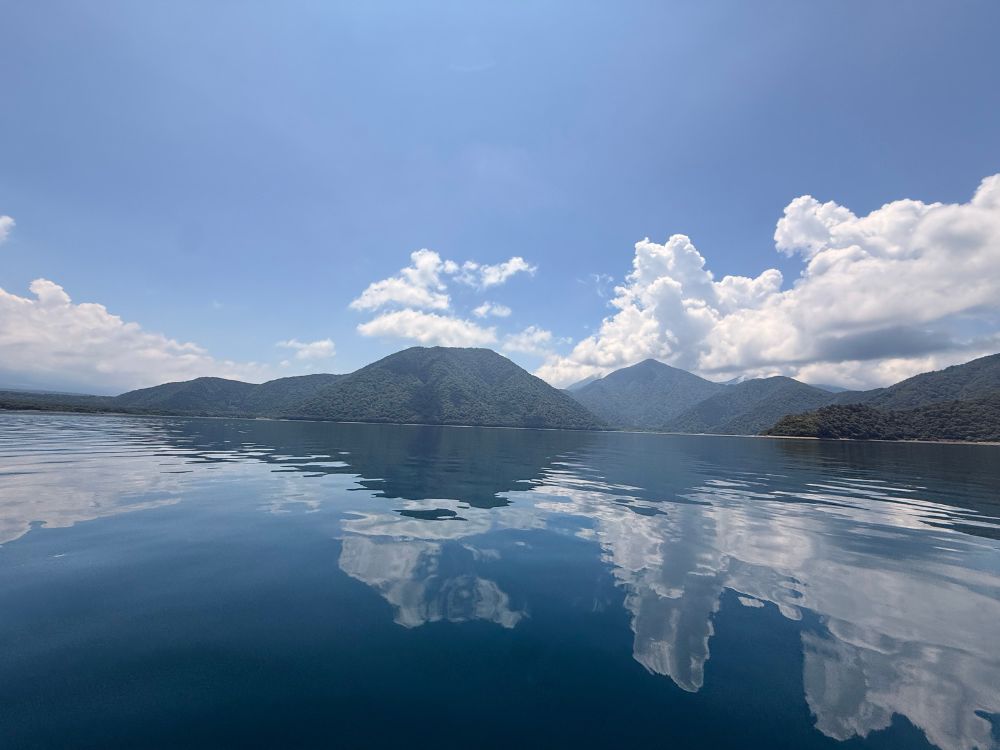
Pick a Day With Little Wind
Wind pushes the board around and makes it rock, which throws off your balance. Check the wind forecast and pick a calmer day.
On lakes, mornings are often completely calm, but the wind can pick up in the afternoon even on a sunny day.
It probably varies by location too, so keep an eye on the weather and go with the flow!
Stay Close to Land (For Watching the Water and Taking Breaks)
Sticking to the shoreline rather than the middle of the lake means you can enjoy watching what’s underwater and take a break whenever you need one. It’s also reassuring to be able to get on land if your kid gets bored.
Watch Out for the Fin on the Back of the Board!
Be careful not to snap the fin sticking out from the back of the board.
⚠️ When you land, always come in “nose-first” to keep the fin from hitting the bottom.
At the place I rented from, you have to pay for it if you break it. Be careful!
Safety Tips
- Life jackets are non-negotiable: both kids and adults must wear one
- Skip it on bad-weather days: don’t push it
- No go on windy days: it turns into a scary experience
- Things look closer than they are: distance is hard to judge on a lake
- Wind direction can mean you barely move even while paddling: knowing when to turn back matters
- Go with at least one other person: so you can help each other if something goes wrong
About SUP Fatalities
SUP is a fun activity, but unfortunately, fatal accidents do happen. There was even one at Lake Motosu in Yamanashi Prefecture, where I go camping.
That said, these accidents tend to share common threads.
Going out alone, getting swept out and unable to get back, or the board drifting away and the paddler drowning — these are the recurring patterns.
In other words, if you take steps to prevent these specific things, you can prevent the accident.
As a rule, go out in a group of two or more (so you can call for help right away if something goes wrong)
Wear a life jacket and leash cord, no exceptions
Keep your phone on you in a waterproof case (in case you need to call for help)
Don’t go out if the weather’s bad, and head back right away if it looks like it’s about to change
Stick to the points above and I think you can enjoy it safely. Have both kids and adults wear life jackets, and put safety first!
Most places that rent SUP gear also rent life jackets.
Watch Out for Sunburn Too!
Sunburn catches a lot of people off guard. Two hours outdoors and two hours out on the water are two very different things.
My kids and I were thorough about sun protection, but my husband, as usual, didn’t bother (lol).
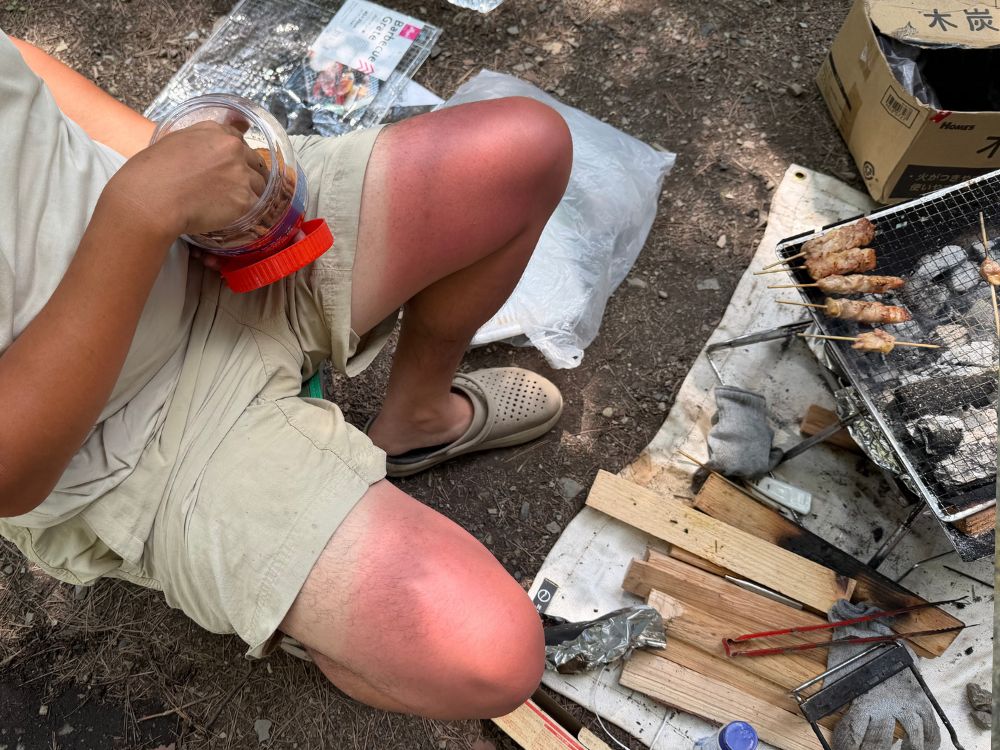
This is what just 2 hours did.
He wasn’t the only one — we noticed quite a few other people who ended up like this too.
People who own their own SUP gear tend to be thorough about sun protection — wearing long-sleeve, long-legged swimwear, and if they’re sitting down, often a hat too.
When you’re applying sunscreen, watch out for uneven spots! And it’s great if you can use something that’s gentle on the environment too.
Thinking About Getting Your Own SUP?
There are countless SUP brands out there worldwide, but here we’ll introduce one internationally well-known brand and one Japanese-made brand.
SUP prices run the full range — cheap ones start around 20,000 yen (approx. $133), while high-end ones can run over 200,000 yen (approx. $1,333).
Non-inflatable boards are cheaper, but they’re bulky to store and transport, so inflatable boards tend to be more popular.
World-Famous: STARBOARD
A globally popular brand with a strong track record of technical achievement, including numerous racing results.
Here’s a quick comparison between a typical board and what sets STARBOARD apart.
A Typical Inflatable SUP
・Seams glued together → risk of air leaks.
・Quality varies by product.
STARBOARD
・Fabric heat-fused into a single piece → almost no risk of air leaks, and it resists wear over time for a longer lifespan.
・Backed by a racing pedigree, with a build designed to track straight.
・It’s a recognized name, so it holds resale value.
Our Pick for Riding With Kids: “STARBOARD iGO Deluxe 12’0″×33″“
This model has an exceptionally wide deck — about 33 in (84cm) — and huge buoyancy at 365L, so even if your kid suddenly stands up or moves around, the board stays steady and the risk of tipping drops significantly.
It also comes with D-rings, so if you add the optional kayak seat, you can sit and paddle canoe-style too.
The board itself weighs about 22 lbs (10.1kg). Air pressure: 15–18 PSI.
Recommended max load: about 265 lbs (120kg).
Check out the STARBOARD I GO WITH PADDLE DELUXE LITE 12’0 X 33!
Build and strength vary a lot from person to person, so if you’re on the smaller side, this might feel too big.
If that’s the case, the KOKUA board I’ll introduce next might be a better fit.
A Japanese Brand: KOKUA
A friend with over 10 years of SUP experience told me their pick was a brand called KOKUA.
KOKUA is a Japan-based brand built around the idea of “designing SUP boards to fit Japanese body types.”
What stands out is how light it is — about 15 lbs (7kg) — and its high air pressure, 20 PSI.
The lighter it is, the easier it is to carry, which makes it easy to handle even for women.
Also, lower air pressure means the board flexes once someone gets on, which makes paddling harder — but higher air pressure keeps the board stable and easy to paddle even with riders on it.
These are heat-welded too, by the way, so just like STARBOARD, there’s little risk of air leaks. They’re also built to handle tough conditions like rocky shores, sandy beaches, and sudden temperature swings, so durability is solid too.
Our Pick for Riding With Kids: “VOYAGER”
Non-slip padding across the entire deck keeps kids from slipping, which is reassuring. It also comes with bungee cords, so you can bring plenty of gear.
It’s also a model that works well for SUP with dogs.
Check out the KOKUA VOYAGER!
If you’re bringing kids, we’d recommend either the KANALOA, which is great for tandem riding, or the VOYAGER, with its non-slip padding! Renting one to try first before you buy is a great option too 😊
Where We Did This: Lake Motosu in Japan
We love Lake Motosu, one of the Fuji Five Lakes in Yamanashi Prefecture in Japan— it’s apparently well known among serious SUP enthusiasts too.
Beyond camping, there are guided activities available too, so it draws a lot of visitors on weekends (note that the campground requires a reservation).
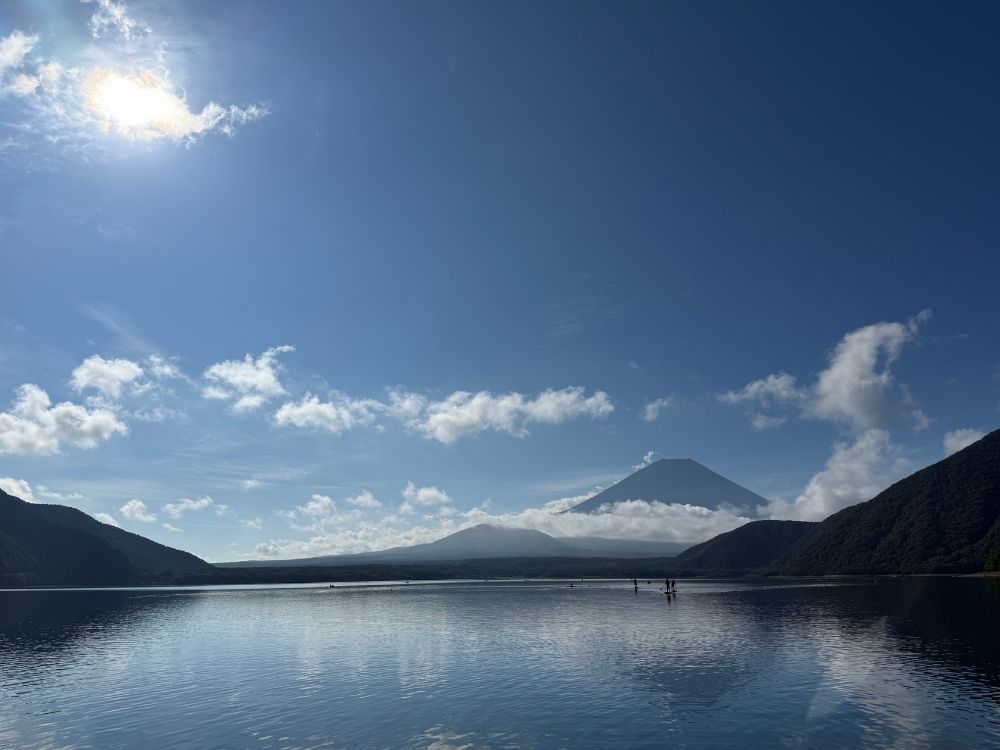
The best part of this spot has to be the view of Mt. Fuji straight ahead.
It’s especially beautiful first thing in the morning, when people with their own SUP boards paddle out onto the quiet lake to take in the view of Mt. Fuji.
You can rent gear right at the campground, and it looks like there are also guided SUP experiences if you’re just there for the paddling.
I’m planning to cover this in more detail in a separate article.
By the way, Klook had a chartered day-camp tour departing from Tokyo. The campground itself is at Asagiri Kogen, a little past Lake Motosu, but it looks like it may offer access to Lake Motosu too (worth checking with their customer service).
I highly recommend it if you live in Japan or ever get the chance to visit!
In Summary
SUP with kids turned out to be a wonderful activity, even for complete beginners.
Bring plenty of food and drinks, stay on top of sun protection and safety, and go enjoy it!
Thanks so much for reading all the way to the end!